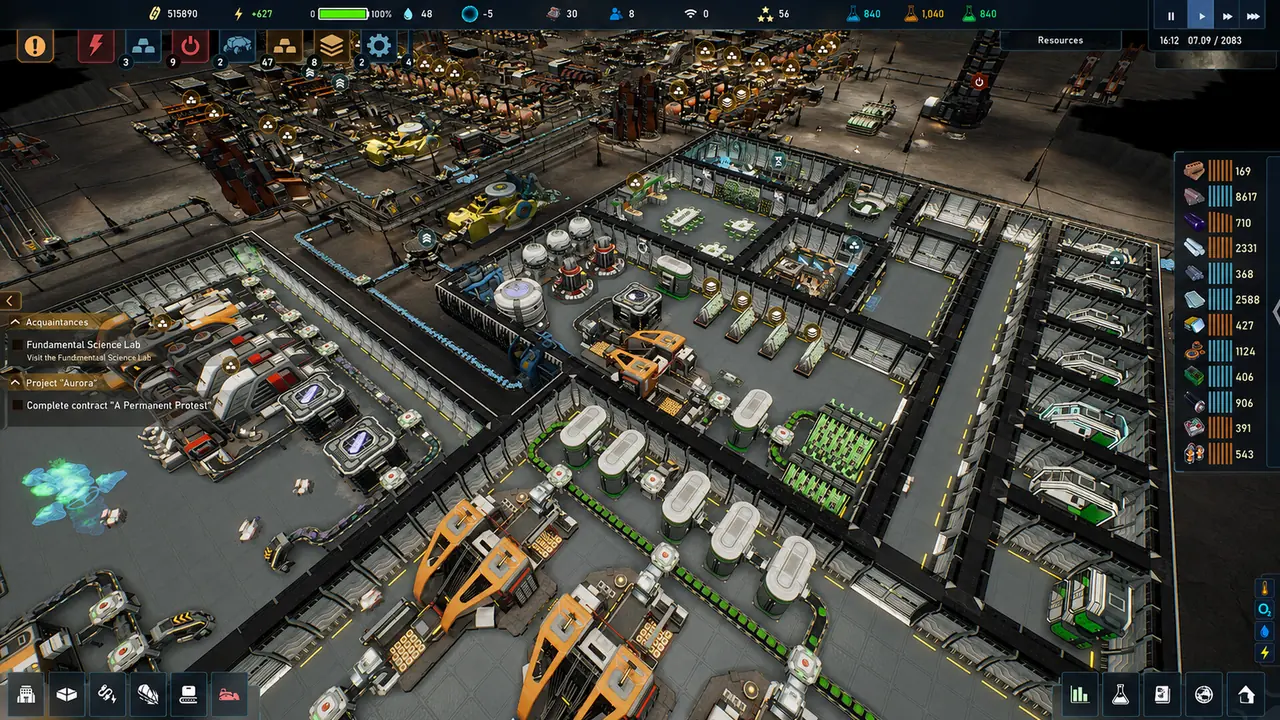
The Crust left Early Access on 10 September 2026, and 1.0 is best understood as three things at once: the campaign finally ends, the game gains two large build tools (Planning Mode and roads), and the whole logistics layer is rebuilt — which is also why your Early Access save will not open. The developer's own summary is unusually candid about the trade: "An Early Access base simply doesn't map onto the new structure, so there's no way to convert old saves. It's the price of the changes that made bigger bases possible."
- Released
- 10 September 2026Left Early Access
- Commits since Update 3
- Over 2,000Developer's figure
- Old saves load
- NoSave-incompatible
- New build tools
- Planning Mode, roadsPlus rebuilt logistics
- New platforms
- macOS and LinuxWindows already supported
- Campaign
- Completed, multiple endingsWas unfinished in EA
Read this first if you played Early Access
Before any feature list, the disqualifying detail, because it decides whether the rest of this page is useful to you.
The developer warned about it the day before launch, and did not bury it: “One thing to know before tomorrow: Early Access saves won’t carry over to 1.0.” Then, plainly: “1.0 is not save-compatible with Early Access builds.”
The reason is a rewrite, not a policy: “The logistics system was restructured from the ground up - that’s where the up-to-50% performance gain on large bases comes from. On top of that, a road system has been added and the excavation system has been overhauled. An Early Access base simply doesn’t map onto the new structure, so there’s no way to convert old saves.”
That is three systems — logistics, roads, excavation — all of which your old base is built on top of. So the honest version for a returning player is this: the base you spent the Early Access period building is not a base you will continue, it is a base you can still visit. The files survive; that specific save simply will not open in 1.0.
The escape hatch is official and worth writing down, because it is the only way to finish what you started:
Your save files aren’t deleted - they just won’t load in 1.0. Want to finish your current base? The last Early Access build stays available as a Steam beta branch. Right-click The Crust in your library → Properties → Betas → select “Previous”. Your old saves keep working there.
One consequence worth noticing: that branch does not have the 1.0 achievements, the new events or the completed campaign. It is a museum with a working door, and the choice between finishing an old colony and starting the 1.0 game is genuinely either-or.
Planning Mode and roads: the two tools that changed how the game is played
The developer is explicit that these two exist for one reason. The pre-launch post frames it around the single most-requested change of the whole Early Access period:
The single most common request during Early Access was “let me build bigger, more permanent factories.” 1.0 answers it directly: Planning Mode, roads and a rebuilt logistics system that runs large bases up to ~50% faster make massive factories practical — and a lot more fun to build.
Planning Mode is described in the release notes as a mode “that lets you lay out a construction plan for modules and conveyors, with convenient copying of modules together with their recipes.” Two details in that sentence carry more weight than they appear to. Copying modules together with their recipes means you are duplicating a configured production unit rather than an empty shell — which changes what a production block is, from something you assemble to something you stamp. And the accompanying “required-resources tracker” lets you total a design’s needs before you start, which is the difference between planning a factory and discovering it.
Roads are presented as a fix for a specific annoyance rather than as a building type:
The game now has a very convenient tool for building roads and parking, which speeds up cargo truck traffic and improves the overall look of your base. Trucks pick the shortest route themselves, taking the nearest road into account.
The problem being solved is named earlier in the same section with a rhetorical question about trucks “sometimes drive onto areas that were never meant for them and clip expensive equipment.” That is worth knowing because it tells you roads are a traffic behaviour system, not decoration — and “trucks pick the shortest route themselves” means you are shaping their path rather than drawing it.
But the geometry work matters less than the third thing. The rebuild that makes big bases possible is the logistics rewrite — the thing that breaks saves. Planning Mode and roads are the visible tools; the invisible change underneath them is what actually raises the ceiling on base size.
The story now ends
The release notes list “Completed story campaign” with a description that is unusually literary for a patch note:
A complete story with multiple endings and thought-provoking questions for reflection and discussion, which put the player in front of a tough choice more than once.
If you played during Early Access, this is the substantive change: the campaign continued across updates and never concluded. 1.0 is where it stops — and stops in more than one way.
The Prologue was reworked too, and the notes make a specific recommendation for new players: “If this is your first time playing The Crust, we recommend starting with it.” It is described as “a scenario about 20 minutes long that introduces you to all the essential basics and lets you transition smoothly into the story campaign,” combining tutorial elements and getting visual improvements. So the answer to “should I skip the tutorial” is now officially no.
Global events: a new pressure layer
Events are the most visible addition to moment-to-moment play, and the release notes introduce them with a joke that sets the tone: “The Moon has no atmosphere, which means nothing will slow down a rock flying at your head.”
Meteorites. “They fall one at a time or in a whole shower, and you cannot choose when or where they land.” The notes also describe the arc a player goes through, which is worth quoting because it explains why the event becomes a problem rather than a nuisance: “While your base is small, most rocks land on empty ground and leave behind debris rich in resources, including rare minerals, so for a while you will be happy about every impact. But over time, the base grows and there is less and less empty space.”
Solar flares. Described as random with two possible outcomes: “This event occurs randomly and can either trigger increased power output from your solar panels (but that’s not certain =)) or damage your buildings and the colonists working at their posts on the surface.” This one has already been patched twice — Hotfix 1.0.8 improved the timer display for it, and Hotfix 1.0.9 reworked the event outright, adding that “Batteries located underground are no longer drained by it.” If you formed an opinion of solar flares in the first week, that opinion is about a version of the event that no longer exists.
Epidemics. A colony-hygiene pressure rather than a medical system: “Epidemics break out when the colony is in chaos and unsanitary conditions. They worsen colonist mood and work efficiency, and in the most neglected situations they can lead to colonist injuries and deaths.” The notes give the counter plainly: “This event is easy to avoid by equipping rooms with showers and toilets and by keeping a positive balance of medicine on the base.”
That last sentence is the reason the Shower/Toilet module is not a joke entry. It is the mitigation for a new failure mode.
Our global events page covers each of these in detail, including which of them the announcement history describes and which it only hints at.
The Anti-Meteorite Laser Cannon, and the endgame it belongs to
The second new module is the answer to the first new event, and the notes describe it with an economy attached:
It shoots down rocks as they approach, but not for free: each shot costs one Energy Cell, after which it needs to recharge. One cannon does not cover the whole base, so decide what to protect first: the reactor or the bar.
Two design decisions are packed into that. Ammunition is consumption — defending your base draws on the same energy cells your grid depends on, so a meteor shower is a resource event as well as a destructive one. And coverage is limited by design — the note explicitly frames it as a prioritisation problem rather than a coverage problem, which means a fully defended base is not the intended outcome.
This module sits inside the game’s largest construction project, which the mission log calls the Laser gun and the patch notes call the laser cannon. We have a full page on that quest, including the stage count, which the shipped build numbers differently from the community wiki.
Everything else 1.0 added, in one place
The release notes end with a list headed “A few more improvements” that runs to about twenty items. Grouped, it reads as the answer to “what actually changed in my moment-to-moment play”.
Building and layout
| Addition | Official wording |
|---|---|
| Interior wall styles | “You can now choose the interior finish style for rooms, and a large set of different wall panels has been added, including wood, steel, stone, and bright wallpaper.” |
| Faster conveyor connections | “Made it easier to connect conveyors to the Assembler and other modules.” |
| Underground level selector | “A level selector has been added to the underground conveyor construction interface.” |
Logistics and automation
| Addition | Official wording |
|---|---|
| Conveyor direction visible and switchable | “you can now see the conveyor’s direction, which can be changed with the V key” |
| More goods per Flight Control Center | “You can now put up to 5 goods up for trade on a single Flight Control Center, and hovering over a resource shows its market price.” |
| Distributor priority by mouse | “Improved Distributor UX/UI. You can now lower priority with RMB.” |
| Multi-Resource Warehouse selection | “Improved interaction with the Multi-Resource Warehouse; added resource selection via CTRL.” |
Colonists
| Addition | Official wording |
|---|---|
| Firing | “We have added the ability to fire any colonist you do not want” |
| Salary control | “The colonist salary management system lets you fine-tune payments, which in turn affect team morale.” |
| Colonists can leave | “colonists can now quit on their own and leave on the next capsule if working conditions become truly unbearable” |
| Training Center | “A POI has been added where you can improve your colonists’ skills. Pick the right staff, send them off for training, pay the corresponding cost, and after a while the colonists will return with upgrades to their chosen profession.” |
Interface and controls
| Addition | Official wording |
|---|---|
| Hotkeys | “Hotkeys have been added for all main functions and menus, and you can customize them in the game settings.” |
| Esc and right-click to back out | “Various UI/UX improvements, such as backing out of any window with Esc and RMB.” |
| Tooltips everywhere | “Tooltips with hints have been added to all buttons and UI elements in the game to make it easier to learn.” |
| Patch notes in the menu | “A news block and patch notes have been added to the main menu.” |
Modes and content
| Addition | Official wording |
|---|---|
| Four new Sandbox maps | “4 new maps (landscapes, craters) have been added for Sandbox mode.” |
| Sandbox 2.0 | “You can now choose your starting position on the Moon, with varied resource compositions. New Custom Game settings have been added, as well as seeds for settings and starting generation.” |
| Online leaderboard | “Detailed player statistics are now recorded in an online leaderboard across several indicators: base capitalization, capitalization growth rate, and other metrics.” |
| Monthly leaderboard | “Starting October 1, a new table will also be added to the game: the Monthly Leaderboard, which is updated every month” |
| Two new achievements | “2 new achievements added: "The Crust" (scan the entire Moon) and "My mom’s friend’s son".” |
| Turkish localisation | “After many requests from the community, we have localized all texts and interfaces into Turkish.” |
| macOS and Linux | “We have done a lot of work and fully ported the game to macOS and Linux.” |
Read the colonists block again, because it is the most consequential set of small changes on the whole page. Before 1.0 you hired colonists and lived with them. After 1.0 you can fire them, can set their pay, and can lose them — because salaries now feed morale and unhappy colonists leave on the next capsule. That turns a resource-management problem into an employment one, and it is the kind of change that reshapes a run more than any single building does.
The release in numbers, all official
- Over 2,000 commits since Update 3 — the developer's own measure of the gap between the last Early Access update and 1.0.
- +30–50% FPS from the logistics rework, and on large bases 100–200% — quoted figures, with the caveat that "the exact increase in FPS depends on your device's specifications".
- Up to ~50% faster on large bases, as stated in the pre-launch post's summary of the rebuilt logistics system.
- Lower memory requirements — "RAM usage has been optimized, the required amount of memory has been reduced, and the minimum PC requirements have been lowered."
- Eight patches in ten days after launch, running from Hotfix 1.0.6 to Update 1.0.12.
Source: official Steam announcements for app 1465470, September 2026. Our performance and settings page breaks the FPS figures down and explains why they are not additive.
What 1.0 is not
Three negative statements, because they resolve most of the confusion around this release.
It is not a new purchase. “Already own The Crust? You already own 1.0 - it arrives as a regular Steam update.”
It is not a graphics overhaul with a feature list attached. The single largest engineering item is in the logistics layer, which is invisible. What you will see on returning is Planning Mode, roads, new events and new interior styles — but the changes that alter what is possible are the ones you cannot look at.
It is not finished in the sense of frozen. Eight patches followed within ten days, including a rework of one of the new events. Treating the 1.0 build on your first evening as the definitive version of these systems is a mistake we would rather you avoided.
If you are coming back after a long break
The release notes include an index for exactly this reader, headed “What has changed since Early Access?”, listing the four major updates that ran during the Early Access period and linking each one. That index is the fastest honest orientation available, and our update history page reproduces it and explains how the numbering works — including why “Update 3” is the oldest post still reachable in the official feed.
The short version of what you missed, in the developer’s own summary of those updates: the New Horizon Update brought outposts, the Helium-3 Harvester and the Thermonuclear Generator; Update Two brought the gas system, five new production resources, auto-trading and the Launch Station; Update 3 brought drones 2.0, contract automation and the Ultra-High Priority System; the Big FPS & QoL Update brought the conveyor optimisation and module naming. If you stopped playing before those, 1.0 is not a patch to catch up on — it is a different game to relearn.
If you only remember one thing
The thing that will actually change your first hour back is not a feature, it is the save. 1.0 cannot open an Early Access base, the developer said so in advance, and the Previous beta branch is the official way to keep playing the old one. Decide which of the two you want before you launch, because the answer determines whether you are finishing a colony or starting one.
Where this leaves you
Three things to carry forward. 1.0 ends the story, adds Planning Mode and roads, and rebuilds logistics — and the third of those is the one that raises the ceiling on base size while also being the reason your old save cannot come with you. The colonist system became an employment system, with firing, salaries, morale and resignations, which is the least-publicised change with the largest effect on a run. And the release has been patched heavily since day one, including a rework of the Solar Flare event, so anything you read about the new features from the launch week describes a build that is already several versions old.
What we have not done is rank the features or tell you which to try first. The developer’s own ordering is the one to trust here — they put Planning Mode, roads and the optimisation at the top, and everything else under “a few more improvements”, which is a fairly clear statement about where the work went.