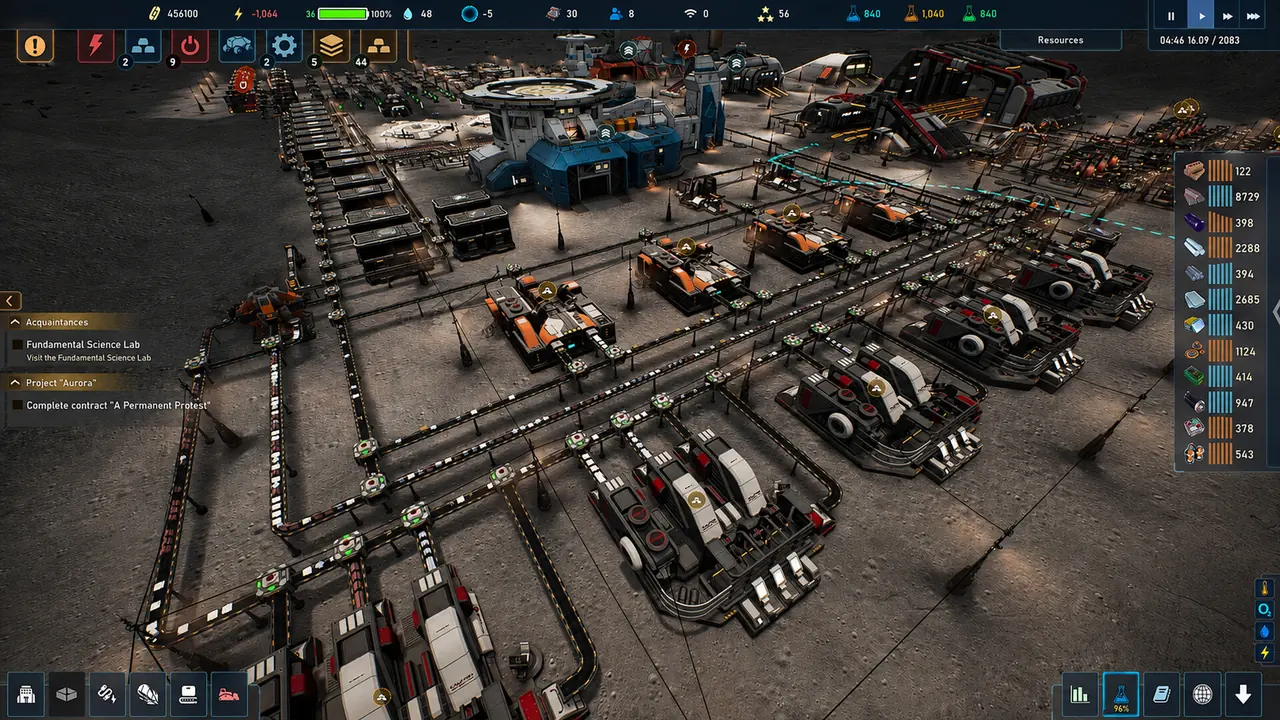
A colony in The Crust survives on four loops running at once: oxygen, water, food and medicine. Oxygen is not mined — it is split out of water. Food is grown, not bought. Medicine is the thing you will thank yourself for stocking before the first epidemic, because the 1.0 announcement is explicit that unsanitary conditions and a thin medicine balance are what cause epidemics in the first place. The order that works: water in, oxygen out, food growing, medicine in reserve.
- Oxygen source
- WaterVia electrolysis
- Food source
- Grown on siteGreenhouses and farms
- Epidemic trigger
- NeglectSanitation + medicine
- Epidemic severity
- Up to deathsPer official 1.0 notes
- Outside the base
- Helmet requiredOxygen is not ambient
- Quitting
- Now possibleAdded in 1.0
What “life support” means here
The premise does the work for you. This is a Moon colony, so there is no breathable atmosphere outside the walls and no biosphere to fall back on. Everything a colonist breathes, drinks and eats is a product of a module you built, powered by a grid you maintain, and moved by logistics you configured.
That makes “colony management” a specific list rather than a vague mood:
| Need | Supplied by | Failure looks like |
|---|---|---|
| Oxygen | Electrolysis from water, then stored and distributed indoors | Colonists outside without helmets; suffocation indoors |
| Water | Extraction and tanks | Oxygen production stops, because water feeds it |
| Food | On-site growing, then prepared in a kitchen | Hunger; colonists idle at meal time |
| Medicine | Produced and kept in reserve | A minor epidemic becomes a fatal one |
The dependency worth staring at is the second row. If oxygen comes from water, then water is not just a colonist need — it is upstream of a colonist need. Losing your water supply does not cost you a resource; it costs you the air.
The oxygen loop, and why the patch notes prove it
The community wiki describes the loop in three steps: an electrolysis plant turns water into oxygen, an oxygen receiver stores it, and a ventilation module moves it between interior rooms. That is a community description and we are labelling it as one.
What makes it trustworthy rather than merely plausible is that the official notes describe the same machine doing the same job. A hotfix in the 1.0 series records fixing “an issue where unfinished or planned Electrolysis Plants could, in rare cases, start producing oxygen.” A planned building producing oxygen is only a bug if the electrolysis plant is the thing that makes oxygen. Independent official text confirms the community description of the mechanism without repeating any of the community’s numbers.
Epidemics: the failure state the game tells you how to avoid
Most survival mechanics in this genre are left for the player to reverse-engineer. This one is not. The 1.0 announcement states the trigger, the effect and the fix in a single paragraph:
- Trigger: “Epidemics break out when the colony is in chaos and unsanitary conditions.”
- Effect: “They worsen colonist mood and work efficiency, and in the most neglected situations they can lead to colonist injuries and deaths.”
- Fix: “This event is easy to avoid by equipping rooms with showers and toilets and by keeping a positive balance of medicine on the base.”
Two consequences follow directly, and they are the reason this page exists:
- Sanitation is not decoration. Showers and toilets are named as the epidemic defence. In a base where you are rationing building slots for production, they look like the optional row. The developer is telling you they are not.
- “Positive balance of medicine” is a stock, not a task. The wording is about a balance, which means a buffer. Running medicine at exactly zero and producing on demand is the configuration the announcement warns against.
A hotfix note confirms the game will at least tell you when it happens: “Added notifications for epidemics.” That is a 1.0.8-series addition, so if you are reading an older guide that never mentions epidemic warnings, that guide predates the feature.
The morale layer underneath
Epidemics are the loud failure. Morale is the quiet one, and 1.0 changed it in a way that has real teeth.
The 1.0 announcement describes salary management as directly affecting morale: “The colonist salary management system lets you fine-tune payments, which in turn affect team morale.” The same paragraph adds the part that catches players out — “colonists can now quit on their own and leave on the next capsule if working conditions become truly unbearable.”
Read those two sentences together and the mechanic is clear: salaries are a lever you can pull down to save money, and morale is the counter-lever that eventually pulls back. It is not a warning about a random event. It is a warning about a decision you make deliberately and forget about.
The surrounding environment feeds the same pool. The community wiki notes that colonist productivity and mental state improve with more pleasant living and working quarters — that is a community observation, but it lines up with the developer’s own choice, in 1.0, to add a wall-panel system whose stated purpose was making rooms distinguishable, including materials described as wood, steel, stone and wallpaper.
Where life support meets the rest of the base
Life support does not sit beside your production chains; it is threaded through them, and a few official fixes show the seams:
- Outside is a different environment. A hotfix records fixing a bug where “building a room around an elevator allowed colonists to walk outside without helmets or oxygen needs.” The intended behaviour is the opposite of the bug: step outside the habitat and the helmet and oxygen rules apply. If you are planning a base with surface access paths, plan the airlocks with it.
- Some modules refuse to share space. Another note fixes “an issue allowing Underground Storage to be built inside living quarters.” Storage and habitation are meant to be separable, which matters when you are laying out a base by hand.
- Life support competes for priority, and the game now lets you rank it. The 1.0 / QoL update introduced a system the notes list as “Priorities for living quarters” inside a broader priority framework. In practice that means when drones are short, you can decide that keeping the habitation blocks serviced outranks feeding a production line.
- Quests route through these modules too. One fix concerns a quest that “tracked the construction of the Pharmaceutical Factory instead of the Medical Center” — evidence that medical modules are quest-relevant buildings, not background scenery.
The order that actually works
| Stage | Build | Because |
|---|---|---|
| 1 | Water supply and the electrolysis chain | Oxygen depends on water; without it nothing else matters |
| 2 | Oxygen storage plus interior distribution | Production without a buffer is one incident away from a crisis |
| 3 | Growing space, then a kitchen | Food is produced, not imported — plan it before the population grows |
| 4 | Showers, toilets, beds | Named in the official notes as the epidemic defence; cheap compared to the downside |
| 5 | Medical module and a medicine buffer | The other half of the epidemic defence, and the one that costs production time |
| 6 | Habitation quality and wall finishes | Feeds morale, which 1.0 connected directly to whether colonists stay |
What this page does not claim. No per-colonist consumption rates, no "days of oxygen per tank" arithmetic, and no production times. The developer has published capacity adjustments but never a consumption table, and the community pages that list figures are tagged to a pre-1.0 build. If you are looking for a number to type into a spreadsheet, we do not have one we can stand behind — and a wrong number is worse than none.