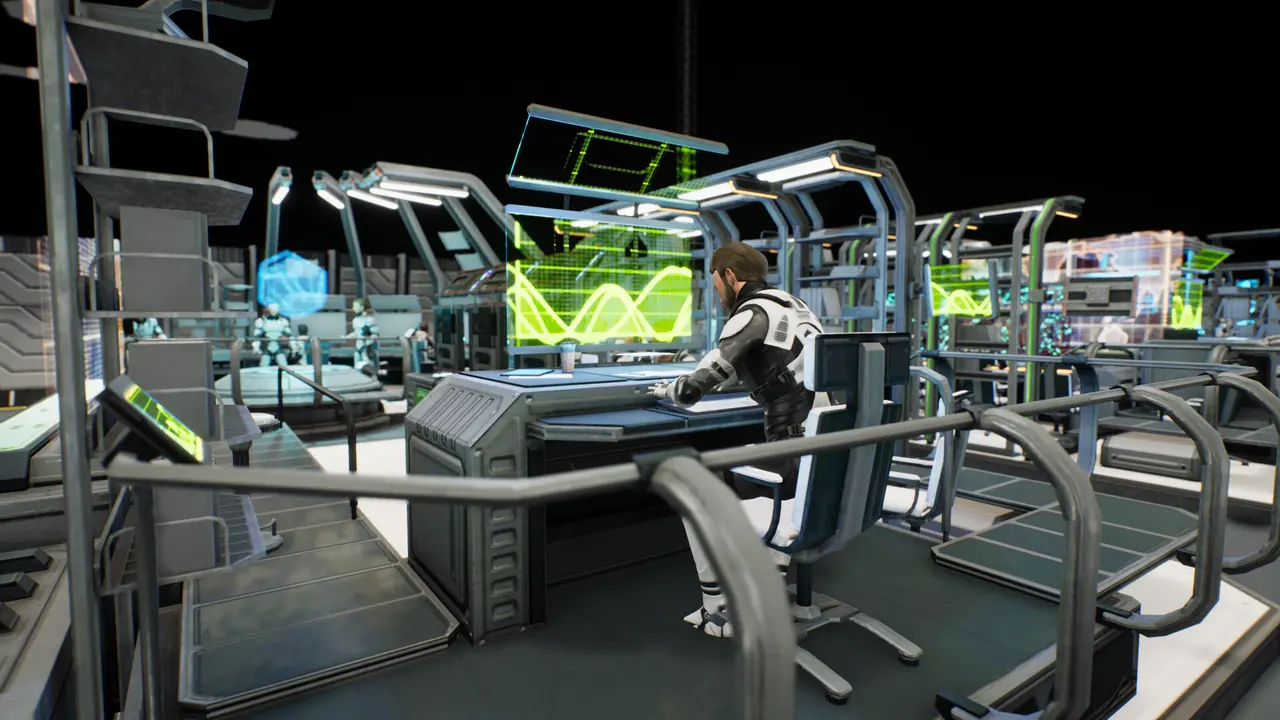
Research in The Crust has three branches whose official names are fundamental, engineering and social — not the colours players search for. Points come from at least seven documented sources, and the game has been steadily raising how many you get while separately cutting the cost of specific technologies. The two things most likely to trip you up are not about order at all: points accumulate now, so you should not treat them as use-it-or-lose-it, and researching an upgrade does not apply it — vehicles charge you credits to install what you have already discovered.
- Branches
- ThreeFundamental, engineering, social
- Colour names
- UnofficialCommunity mapping only
- Points
- AccumulateUnused points flagged
- Purchase
- SupportedCRUST store
- Install cost
- SeparateCredits, per vehicle
- Press Space
- Pause in placePlan the next step
Three branches, and the colours you actually searched for
The most common way people ask about this system is by colour — “blue research”, “green research”, “no green science”. The colours are real shorthand, but they are not the game’s vocabulary. Official text is consistent and unambiguous about the branch names:
“Increased the cost of late-game research in the fundamental and engineering branches by 2–4%.”
“Increased the production-automation reward in fundamental, engineering, and social points by 20%.”
“Reduced the cost of some research in fundamental and engineering science points, increased in social science.”
So there are three branches, and they are fundamental, engineering and social. The word “branch” is the developers’ own.
The colours come from elsewhere. The community wiki’s Research System page maps them explicitly — Orange Science = Engineering, Blue Science = Fundamental, Green Science = Social — and that page’s own research-cost templates are written with parameters like bluesci and greensci, which is why the colour vocabulary spread.
We are giving you both vocabularies and being clear about which is which. Use the official names when you read patch notes; use the colours only as a translation key for community material. If your research panel labels a branch differently from the mapping above, trust the panel.
The same community page also describes what each branch is for, which is the more useful part:
| Branch | Community description of its focus |
|---|---|
| Fundamental | Unlocking and upgrading vehicles and the buildings of the power system |
| Engineering | Production, storage and mining buildings |
| Social | Buildings required by colonists and the trading system |
That framing is consistent with official usage — the conveyor tier researches, for example, sit in engineering, and an official note says slag-processing recipes require research “in the engineering research tree.” Power and vehicles sitting together in fundamental also explains why an Electric Pillar connection research is a research rather than a building.
The Research System wiki page is genuinely useful — it is our only source for the colour mapping, and its description of the three branches' focus areas matches official usage. But it also carries two clear staleness markers we want you to see rather than discover later.
It is tagged Version 0.95.67 and flagged Stub — a pre-1.0 version and an acknowledged incomplete page.
And one of its claims is now false. The page states that "There is currently no way to store unused science points." Hotfix 1.0.8 added an exclamation mark next to unused Science Points in the Research menu — a feature that only makes sense if points persist. The page is wrong on this point, and it is wrong in the direction that matters, because the outdated claim would lead you to spend points you could safely have banked.
Source: thecrust.wiki.gg community wiki, Research System page, tagged version 0.95.67 with a stub notice. Community tier; mechanism accepted, stale claims identified.
Where science points actually come from
Seven sources are documented in official text. Listing them together is worth doing because most guides cover two or three and leave players short of points without understanding why.
1. Science labs in your base. The named modules are the Fundamental Science Lab, the Social Science Lab, an AI Science Center added in 1.0, and a Private Laboratory that appears in story content. Power consumption was added to the fundamental and social labs in an April 2026 update — before that they were effectively free to run.
2. Outposts. Points generated out on the moon are substantial enough that the developers tuned them twice: an official note added “a tutorial on generating Science Points at an outpost,” and an earlier balance change “Reduced the average science point generation at outposts by roughly 25%.” The outpost is a research source as well as a resource source.
3. Story missions. Mission rewards are tracked per branch and get rebalanced. One balance note records that the reward for the underground oxide mining mission had “fundamental and engineering science points increased by 25%, social points removed.”
4. Contracts and expeditions. Update 3 lists “Automation of contracts, expeditions, and unit production” as a highlight, and a research exists that lets a Multi-Storage automatically supply contracts and expeditions with exactly the resources they call for.
5. Relationships with organisations. Update 1.0.12 “Increased the amount of Science Points awarded for reaching a new level of relations with organizations.” This is the most easily overlooked source in the game — it rewards diplomacy rather than production.
6. Research anomalies. Update 0.99.88 records reductions to both the number of science anomalies in orbital generation and their total points, which confirms anomalies as a real income stream that the developers were trimming.
7. Buying them. There is a purchase route: official notes reference a “buy science points” button in the research tree, a “CRUST Solution Science Points store” that received new speed-related research options in Update 1.0.12, and a repeatable research for converting science points into credits added in April 2026. So the flow runs both ways — you can buy points, and you can sell them.
And a bonus tie-in worth naming: automation itself pays research points. An official balance note “Increased the production-automation reward in fundamental, engineering, and social points by 20%.” A well-automated base is a better-funded one.
Why “what should I research first” has no fixed answer
This is the question the page exists to answer, and the honest answer is that the developers have deliberately avoided settling it. Their own patch history shows the research map being moved, not optimised:
- “Sped up progression through the research tree.”
- “Research map changes: the Medical Center is now researched after the Pharmaceutical Factory.”
- “Changed the research positions of the Medical Center and the Pharmaceutical Factory.”
Two separate notes about the same pair of buildings, in opposite directions across different updates. That is a map in motion.
What you can extract from the history is a signal about intent, because cost reductions are the closest thing to a priority statement a developer can make. The June 2026 update cut a specific seven-item set by 10–25%:
“Reduced the cost of starting researches: Regolith Extractor, Regolith Refinery, Rolling Mill, Parts Factory, High-Voltage Transformer, Medium Solar Panel, Mk1 Conveyor Belt by 10-25%.”
Read that list as a curriculum. It is mining, first-tier refining, first-tier manufacturing, power distribution, basic generation and the first conveyor tier — in other words, exactly the technology a base needs to become self-sustaining. Since then, Update 1.0.12 cut a much longer list, again weighted toward the same foundations plus storage and logistics: Large Storage, Large Bulk Storage, the Cargo Dock, the Programmable Conveyor Distributor, the Small Vehicle Assembly Facility, the Robot manufacturing technology and Roads.
The practical conclusion is a pattern rather than an order: the cheaper a technology has recently become, the more likely the developers intend it to be part of your early path. Everything else is downstream of what your map, your difficulty and your colony layout happen to need.
Cost cuts are the developers telling you something. When one update reduces the price of six specific storage and logistics technologies and one manufacturing technology, it is not random tuning — it is a statement that these were gating players too late. If you are unsure what to research next, look at what has recently been made cheaper, and treat the list as a suggested path rather than a law.
Researching is not applying
This is a small rule with an outsized effect on how the game feels, and an official note states it without hedging:
“Applying researched upgrades to rovers, cargo trucks, and rockets now requires credits. You can upgrade rovers and cargo trucks via their interfaces, and rockets at the Launch Station.”
Before that change, research alone gave you the upgrade. After it, research gives you the right to buy the upgrade, and each vehicle charges separately.
The consequence is that a research can be complete, paid for, and still produce no visible change in the field — because you have not installed it on the individual vehicles. The same logic explains a separate detail in the patch history: an official fix addresses rover upgrades failing to apply if they were installed before the vehicle left the base. Installation is a physical step, performed somewhere, on something.
The Tech Center belongs in this story too, though its role has been confused by the game’s own renaming. An official update notes that “The Technology Center module has been updated; it provides temporary upgrades that can be bought for credits,” and the same module is referred to elsewhere as the Tech Center, where its “core functionality” is buying “temporary boosts for your base” that affect “production, logistics, and personnel” — including a boost that raises power output. It also sells a research-speed boost.
Two properties matter. These boosts expire — the developers’ own aside is “Just don’t forget to scale up your power infrastructure eventually, as boosts do expire”. And their values move: an official note “Research speed boost from the Tech Center reduced: 20% → 15%.”
The community wiki's Tech Center page describes a building that "allows storage, repair and upgrade of light vehicles" and lists Heavy Engineering as its prerequisite research. That page is tagged Version 0.99.82.7.
Official notes show the module being repurposed twice after that: by Update 0.99.88 it was selling buffs (a fix mentions failing to apply its colonist-training upgrade), and by 1.0 the announcement describes it as providing "temporary upgrades that can be bought for credits."
We flag this because it is a clean example of why source hierarchy matters. A community page that was accurate when written becomes actively misleading when a developer repurposes a building — and the repurposing here was described in the official patch notes the whole way.
Source: thecrust.wiki.gg community wiki, Tech Center page, tagged version 0.99.82.7, versus official notes from 0.99.88 and 1.0.
Reading the research interface
The research screen has been the target of a series of quality-of-life changes, and knowing what it can do saves real time:
- You can pause and speed up from inside it. An official note describes the research menu being changed so that “You can also pause the game directly in this window to calmly plan your next research steps, or speed it up and watch the progress of newly researched technologies.” Planning research without leaving the screen is the intended workflow.
- It shows game speed, not just pause. “Improved the game speed indicator in the research window. It now shows the current game speed in addition to pause.”
- There is a pause indicator on the tree, added in a separate patch, so a paused game is visible from inside the tree.
- It scrolls further than it used to — “Increased the scrollable area in the research tree.”
- Empty research slots are stated, not implied. The interface displays “No research selected” on the left when nothing is queued, which is the message to look for if you have not realised a slot is idle.
- Unused points are flagged with an exclamation mark in the Research menu.
- Repeatable research exists at the end of the tree. One patch fixes “an issue where repeatable research at the end of the tech tree would complete instantly” — so late-game repeatables are a designed feature, not a bug, once they behave.
- There are three library-style repeatables that matter: converting science points into credits, and the auto-sell/auto-buy capacity research lines.
What the interface does not give you is a shortcut past the gate on the big rockets. The CRUST and UNIVERSE rockets have story requirements, and official notes show those requirements being documented and fixed: “Updated the story requirement descriptions for unlocking the CRUST and UNIVERSE rockets,” and a fix adding a description for the third requirement of the CRUST rocket research.
What this page does not claim. No tech tree diagram, no per-technology costs, and no definitive research order. There is no official screenshot of the research tree, so any diagram you see — including community ones — is a rendering from a specific version and will drift. Research costs have been cut or raised in at least six separate updates since release; read the costs off your own panel, and use the direction of the developers' cost changes as your guide to what was meant to come earlier.