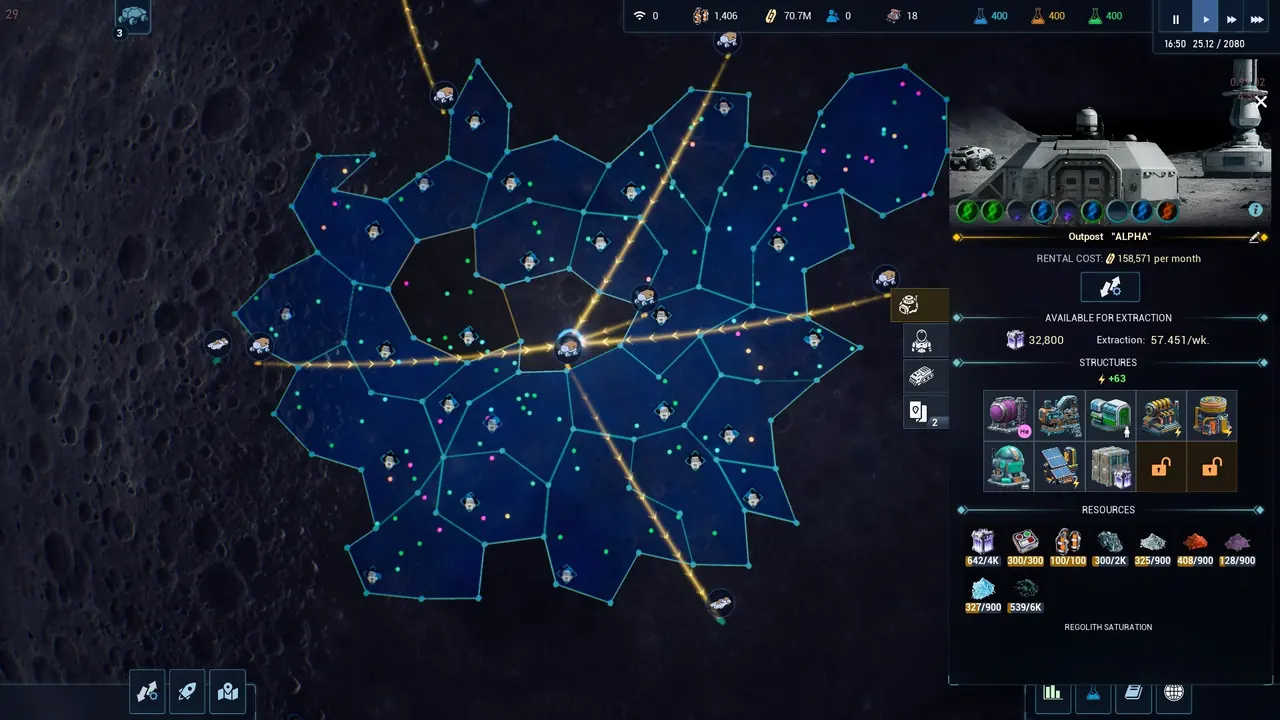
An outpost is the game's second economy. It sits somewhere else on the Moon, it costs you money every month whether or not it produces, and it does one job — usually gas, refining or smelting — better or cheaper than your main base can. The three things worth understanding before you take one on are that it is a recurring cost rather than a purchase, that it is a Science Points source as well as a production site, and that the 1.0 release finally made leaving one possible. Everything else is optimisation.
- Cost model
- Per monthPlus a plot price
- Removable
- Since 1.0Or transferable
- Earns science
- YesTutorial added in 1.0.8
- Labour model
- SharedSplit across modules
- Best module
- SmelterOxides to metals
- Known bug
- Refinery stallFixed in 1.0.10
What an outpost is for
The developers were unusually direct about the intent, and it is worth quoting because it predicts everything else about how outposts behave. Announcing the Smelter module they wrote:
“We are expanding the functionality of outposts by developing the concept (spoiler) of trade and transport logistics on the global map. In this update, we are adding a smelter capable of processing oxides into primary resources: steel, titanium, silicon, and aluminum. This already allows for the creation of more specialized outposts and the establishment of automated delivery routes for finished resources to the main base.”
Three things follow from that paragraph. Outposts are meant to be specialised — one site, one job — not miniature copies of your base. The route home is part of the design, not an afterthought. And the trajectory is toward the global map becoming a logistics network, which is why an update later added the ability to “transport oxides between outposts” — site-to-site transfer, not just site-to-base.
The word “spoiler” in that quote is also honest signalling: this system was still being built out after release, and it is the single most-changed area of the game outside of balance numbers.
Reading the outpost panel
The second image on this page is the outpost interface, and it is worth walking through field by field because a couple of them are self-explanatory only once you know what the site is doing.
| Panel field | What it tells you |
|---|---|
| Outpost name | The site is named — here, a short designation in quotes |
| Rental cost, per month | The recurring charge for holding the site |
| Available for extraction | The size of the deposit underneath, before you build |
| Extraction rate, per week | How fast that deposit is currently coming out |
| Structures count | How much is built on the site, as an at-a-glance complexity figure |
| Resource list | Everything currently held or produced there |
| Regolith saturation | A depletion-style reading on the regolith itself |
Two of those deserve emphasis. “Available for extraction” is a finite quantity, which is why an outpost is a decision with an end date rather than a permanent expansion — the panel is telling you what is left, and the extraction-per-week figure tells you how fast you are spending it. And regolith saturation is a separate reading from the resource list, which fits what the community has documented about regolith carrying varying richness per oxide: what you pull out is not uniform, so a site’s value is not simply its tonnage.
The interface in this screenshot prices a site by the month. The official notes describe the same mechanic, briefly but unambiguously: "Fixed a bug where zone rent was charged even if no Outpost was built in the rented area." That single line from the New Horizon Update of 10 July 2025 establishes both the word and the recurrence.
Two further official lines describe how the price behaves rather than what it is. The same update's balance section reads "Rebalanced zone construction costs, rental prices, and the price growth curve based on Outpost size and number," and Update 0.99.14 later "Adjusted outpost rental costs based on number of outposts owned" while raising "the cost curve for purchasing additional outposts." Read together, the monthly charge scales with how large the site is and how many sites you already hold — which is a design lever you can plan around, not just a bill.
What the notes never do is print the figure. That is the limit of this panel, and it is a narrower limit than it first appears: the mechanic is official, the number is not, and this page will not manufacture one.
Sources: official Steam store screenshot of the outpost management panel; official New Horizon Update (10 July 2025) and Update 0.99.14 patch notes. Interface text transcribed directly from the screenshot.
A recurring cost changes how you evaluate a site. A one-off purchase is judged on payback time. A monthly charge is judged on throughput — a site that produces steadily and cheaply is worth holding indefinitely, and a site you are not currently using is bleeding credits for nothing. That is the strongest argument for why outpost removal had to exist before the design was finished.
Removing an outpost, and why it took until 1.0
For most of Early Access the answer to “how do I get rid of this outpost” was that you could not. The 1.0 announcement closed that gap:
“Outpost removal. Added the ability to remove Outposts and transfer them to other Organizations.”
The roadmap post that previewed 1.0 had already grouped it with selling hardware: “Sell MDRs (mobile drilling units) and harvesters, remove outposts.” Reading those together gives you the shape of the exit path — the game treats an outpost as an asset you can divest, alongside the vehicles you send to it. And because removal pairs with transfer, clearing a site can mean handing it over rather than demolishing it.
Two practical notes. First, the interface had been prepared for this earlier: Update 3 “Increased visibility of outpost boundaries,” so by the time removal shipped you could already see what you were managing. Second, boundary removal is a separate interaction with its own gesture — Update 3 “Changed territory removal from double-click to hold action.” If a claim will not clear, hold rather than double-click.
Science Points: the outpost’s second output
The most underrated fact about outposts is that they are a research source.
The evidence is a tutorial. Hotfix 1.0.8, released four days after launch, added “a tutorial on generating Science Points at an outpost.” That is a strong signal in two directions at once: it confirms the mechanic is live in the shipped game, and the fact that the developers had to teach it suggests it was not obvious to players.
The counterweight is a balance pass from Update 0.99.88, which “Reduced the average science point generation at outposts by roughly 25%.” Read those two together and you get the accurate picture: outpost science is real, it is deliberately modest, and it was tuned down rather than switched off. The same update also cut “the number of science anomalies in orbital generation by 10%”, which fits a consistent pattern — the developers were pulling back on passive science income across the board while keeping active sources.
For a player stuck on a research tier with credits and colonists spare, an outpost is a slower but legitimate path. For a player expecting it to replace laboratories, the 25% cut is the answer.
What actually changes when you build at an outpost
Not every module behaves the same off-base, and several official changes make that clear.
The Smelter is the flagship. Update 3 introduced it, and Patch 0.99.82.7 followed up with “Added research upgrades for the outpost Smelter” and “Rebalanced the work speed of the outpost Smelter and Regolith Refinery” — notice that the patch names those two modules specifically as outpost concerns. The Refinery had been an outpost module since long before; the Smelter joined it.
Gas extraction is an outpost speciality, and its limits were loosened. Update 0.99.87 “Removed the limit on the number of Gas Extraction Facilities at an outpost,” “Reduced the cost of Outpost Gas Extractor upgrades by 50%” and “Increased the efficiency of Outpost Gas Extractors from 10% to 15%.” Three separate changes all pushing gas at outposts in the same direction.
Upgrades at outposts are priced differently from your base. Update 3 “Increased the upgrade cost of the Fuel Generator and RTG for outposts from 30,000 to 45,000.” Power modules at a remote site cost more to upgrade than the same modules at home — a deliberate premium for operating off-base.
Anomalies can buff a whole site. Update 0.99.87 “Balanced the anomaly that improves solar panel generation at outposts: 15% → 20%.” Anomaly effects scale with the site, which is another reason to probe a region before you commit to it.
Outpost value counts toward your company. Update 3: “Outpost resource value is now included in total capitalization.” If you are chasing the market-capitalisation achievements, outposts contribute.
And your colonists grow there. The 1.0 notes state “Colonist experience now grows while working at Outposts.” For career-level progression, a remote posting is not a dead end.
Two ways an outpost breaks, both documented
Known bugs are useful content precisely because the developers wrote them down. Two matter here.
The Refinery stall. Patch 0.99.78 fixed “an issue where the Regolith Refinery on an outpost did not function despite all requirements being met.” Hotfix 1.0.10, three weeks after launch, fixed it again: “Fixed an issue where the Regolith Refinery at an outpost would not work in some cases.” The recurring qualifier — requirements satisfied, module still inert — is the diagnostic signature. If your only symptom is a refinery doing nothing with power and input connected, this is not a design problem, it is a version problem. Update.
The disappearing filters. The Big FPS and QoL Update fixed “an issue where filter buttons disappeared when selecting an outpost” — and a UI bug that removes the controls you need to configure a site reads to a new player as a missing feature. It was a bug.
What this page does not claim. No rental prices, no plot costs, no extraction rates, no Science Point yields and no upgrade figures beyond the ones quoted. Outposts are mentioned in 33 of the 147 official posts — 171 mentions in all — and were re-tuned repeatedly across that four-year span, so this page's hero is a single screenshot from one save and we will not present its numbers as constants. What is documented: outposts charge money per month on a curve that scales with site size and how many you hold, hold a finite deposit, earn Science Points, run specialist modules including a smelter, distribute colonist labour across whatever you build, and can now be removed or transferred.