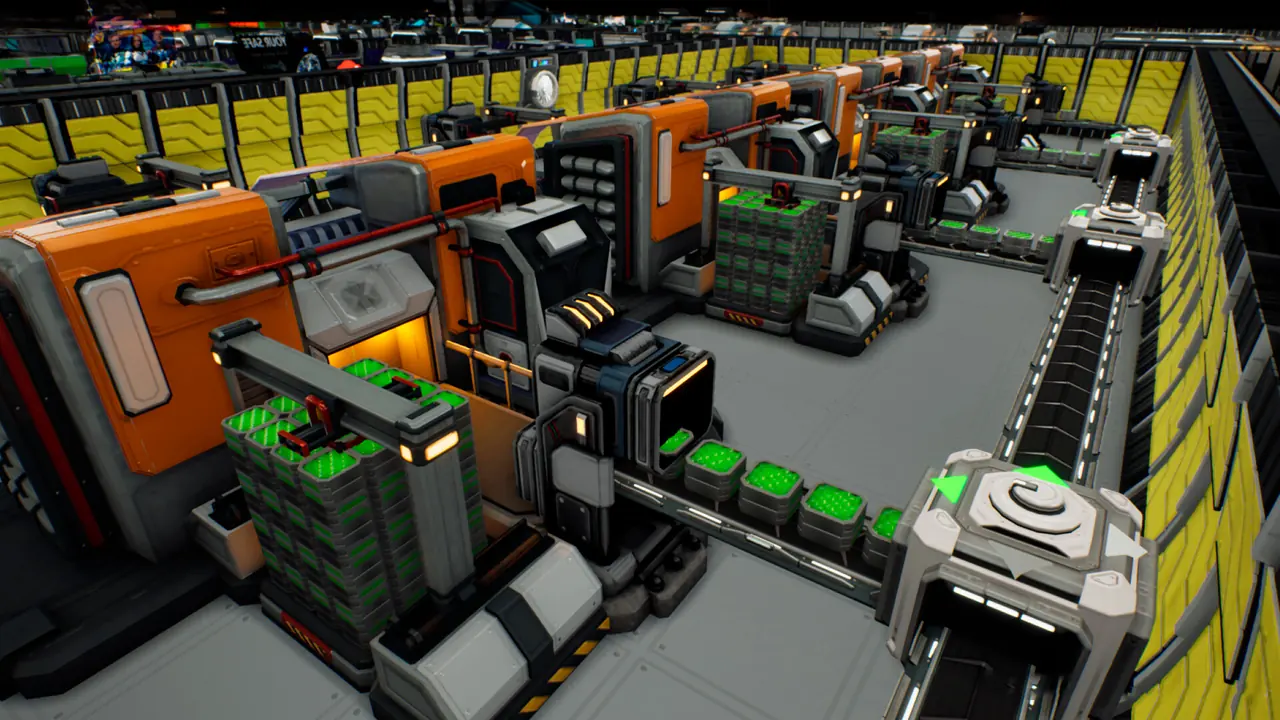
Refining in The Crust has one job: turn rock into oxides, and oxides into metal. Everything else — the layouts people share, the ratios they argue about, the purifier that gets a second life — hangs off that two-step chain. The good news is that both steps are documented in official text by name, including what the game does with slag, which was one of the developers' most-requested fixes. The bad news is that any ratio table you find is a snapshot: smelting quantities and cycle times have both been changed by patches since release.
- Input
- RegolithFrom veins or surface debris
- Intermediate
- OxidesFour types
- Outputs
- Steel, titanium…Plus silicon, aluminium
- By-product
- SlagTwo documented uses
- Second refining
- Research-gatedChemical processing
- Branch
- EngineeringResearch tree location
The chain, by the names the game uses
Refining guides often drift into describing generic factory layouts. This game has a specific chain and a specific vocabulary, and using the right names makes every other guide — and the in-game menus — easier to read.
| Stage | Module | What it does |
|---|---|---|
| Extract | Regolith Extractor | Pulls regolith out of a vein or deposit |
| Refine | Single Regolith Refinery | Regolith in, oxides out — one oxide type at a time |
| Refine (advanced) | Multi-Regolith Refinery | Regolith in, all oxide types out, in one footprint |
| Refine (specialist) | Rare Minerals Refinery | The rare-earth side of the same idea |
| Smelt | Smelting Furnace | Oxides into the primary metals |
| Smelt (remote) | Outpost Smelter | The same conversion, out at an outpost |
| Recover | Regolith Purifier | Gains a second role processing slag in the late game |
The two purifier rows are the ones people miss. Update 3 introduced the slag-processing route with a phrase that is easy to read as flavour text and is not:
“advanced chemical processing of slag—which allows you to extract valuable oxides or rare-earth minerals from large slag deposits using a regolith purifier, which itself gains a second life in later stages of the game.”
A module you built early, for one purpose, becomes part of a second production line later. That is worth knowing when you are deciding where to put it, because a purifier you tucked into a corner in your first hour is a purifier you will want conveyor access to in your twentieth.
Parallel to refining runs the manufacturing tier — Rolling Mill, Parts Factory, Microcircuits Factory, Smart Concrete Factory, Hi-Tech Constructor, Fabricator, Press, Fuel Factory, Electrolysis Plant, Assembler, Mineral Processing Plant. You do not need all of these to start refining, but two of them are relevant immediately: the Press consumes regolith for smart concrete, and the Smart Concrete Factory consumes slag.
Oxide is the hinge, so protect it. Oxides are the only resource that both basic metal production and advanced plate recipes depend on. That makes an oxide backlog more expensive than it looks: it does not just stall smelting, it stalls the tier above it too. When you are deciding what to add storage to next, oxides are rarely the wrong answer.
Slag: the two things you can actually do with it
“What do I do with my slag” is one of the most searched questions about this game, and the reason is that for a long time the answer was “not much.” The developers said so themselves, in the update that fixed it:
“We’ve long been asked to provide more ways to use slag. Thanks to new research into deep slag refining, secondary processing is now possible, allowing you to extract oxides and rare-earth minerals from slag.”
So there are two destinations, and they are different in kind.
1. Slag as an ingredient. The Smart Concrete Factory consumes slag in its recipe, and the Press consumes regolith for the related smart concrete line. This is the low-tech answer: slag is feedstock for construction material.
2. Slag as an ore. This is the one that changes your base. With chemical processing researched — in the engineering research tree, as the developers specify — a refinery can run secondary slag-refining recipes that yield oxides and rare-earth minerals. The by-product of your first production tier becomes input to your second.
That second route has been tuned repeatedly, which tells you it matters. Official notes record an early research “for advanced slag processing to extract rare earth minerals,” and later reductions in how much slag the secondary recipes consume, balanced against longer cycle times. One note even records the secondary slag processing speed in the Single Regolith Refinery being adjusted, and the phrasing is worth seeing as-is: “Secondary slag processing speed in the Single Regolith Refinery reduced: 15 → 30.” The word “reduced” next to a larger number is the kind of ambiguity that appears in patch notes written in a second language — read the number rather than the verb, and confirm on your own build.
The June 2026 balance update contains some of the most specific refining data ever published for this game: oxides in the smelting recipes for steel, titanium, aluminium and silicon reduced from 3 to 2 per resource unit with cycle time lengthened by 30%; oxides in the Hi-Tech Constructor and Fabricator alternative recipes for duralumin plates, titanium plates and modular frames reduced by 25–30%; slag in the Smart Concrete Factory recipe reduced from 5 to 4.
We are reproducing that shape rather than asking you to memorise it, because all of it predates 1.0 and some of it predates several hotfixes. What it does establish is the direction of the design: the developers have been consistently reducing how much oxide a unit of output costs while lengthening cycles. In plain terms — refining got more efficient per unit of input and slower per unit of time. That means throughput planning should assume you need more machines, not more ore.
Source: official Balance and QoL Update, 11 June 2026, app 1465470. Figures are historical and labelled as such; they are not presented as current values.
Single versus Multi: the comparison worth making properly
This is the question the page title is named after, and the useful answer is not “which is better” but “which failure are you willing to manage.”
The community wiki describes the Single Regolith Refinery as designed for minimal construction cost at the price of limited function: it extracts oxides from regolith but “can only extract one type of oxide at a time.” The Multi-Regolith Refinery is described as the reverse — significantly larger, “allowing it to hold more chemical reagents and have multiple conveyor lines for various oxides,” and able to “separate virtually all types of oxides from slag, thus replacing several standard refining units.”
So the trade is legible:
| Single | Multi | |
|---|---|---|
| Oxide types per unit | One | All |
| Footprint | Small | Large |
| Power and CPU draw | Low | Substantially higher |
| Failure mode | Its one output backs up | Any output backing up stops it |
| Best for | Tying production to one local vein’s chemistry | Consolidating a broad refining stage |
The failure mode is the part that decides real layouts. The wiki is explicit that a Multi “will stop operation if ANY of the output slots are filled up” and that continuous output therefore requires you to “keep consuming (or storing) all outputs at production rate.” A Multi is not a drop-in upgrade to a Single — it is a different contract with your logistics network. If you cannot guarantee that all four oxides have somewhere to go, a Multi will spend its life stopped, and two Singles pointed at two different oxides will outproduce it.
The same page carries an honest admission that belongs in any layout discussion: it notes that “in-game upgrade descriptions may be misleading and Mk.2 output seems to be bugged.” We are not going to design a layout around a self-declared uncertain upgrade. Build one, watch the numbers, and scale what you measured.
Both refinery pages on the community wiki carry Version 0.99.55 tags — pre-1.0 — and their headline figures have already been overtaken. The Single's listed power draw is lower than the value an official balance update set it to, which means the page is describing a build that no longer exists.
Their production tables are also conditional in a way that is easy to miss: the values are stated as base production "assuming the input Regolith has a richness of 100% of the target ore." Richness varies by vein and by map, so those tables describe a best case, not a typical one.
We cite these pages for the mechanism — one oxide at a time, all-outputs-blocking, slag pass-through — because that part is consistent with every official mention. We do not reproduce their throughput numbers, because they are both stale and conditional.
Source: thecrust.wiki.gg community wiki, Single Regolith Refinery and Multi-Regolith Refinery pages, both tagged version 0.99.55. Community tier; mechanism only.
Why a refinery stops, in the order to check
A stopped refinery has four plausible causes, and checking them in this order resolves most cases in under a minute:
1. Outputs are full. For a Multi, one full output is enough. For a Single, the single oxide it produces has nowhere to go. This is the most common cause by a wide margin because it is a success condition — you produced more than you consumed.
2. Input is not arriving. Check the belt, the extractor feeding it, and whether the vein has been depleted. An official fix records overfilled drills continuing to drain the deposits beneath them — a bug, but it points at the relationship worth understanding: a stalled drill and a depleted vein look identical from the refinery’s side.
3. The recipe is wrong for the vein. A Single is locked to one oxide type. If the regolith feeding it is chemically the wrong feedstock, or if you built it expecting one oxide and it is set to another, the module is working correctly and producing the wrong thing.
4. The module has no power or no staff. Refining is one of the heavier power draws in the game, and an official balance note raised the Regolith Refinery’s consumption specifically. A refinery that is connected but starved will present as stopped.
What this page does not claim. No throughput tables, no refinery-to-smelter ratios, no optimal layout schematic, and no support for a "mixing regolith" mechanic — we searched the official patch-note history and found nothing by that name. The two things we do assert are structural and documented: regolith goes to oxides, oxides go to metal, slag has exactly two destinations, and a Multi refinery is only as good as the weakest of its four output routes.