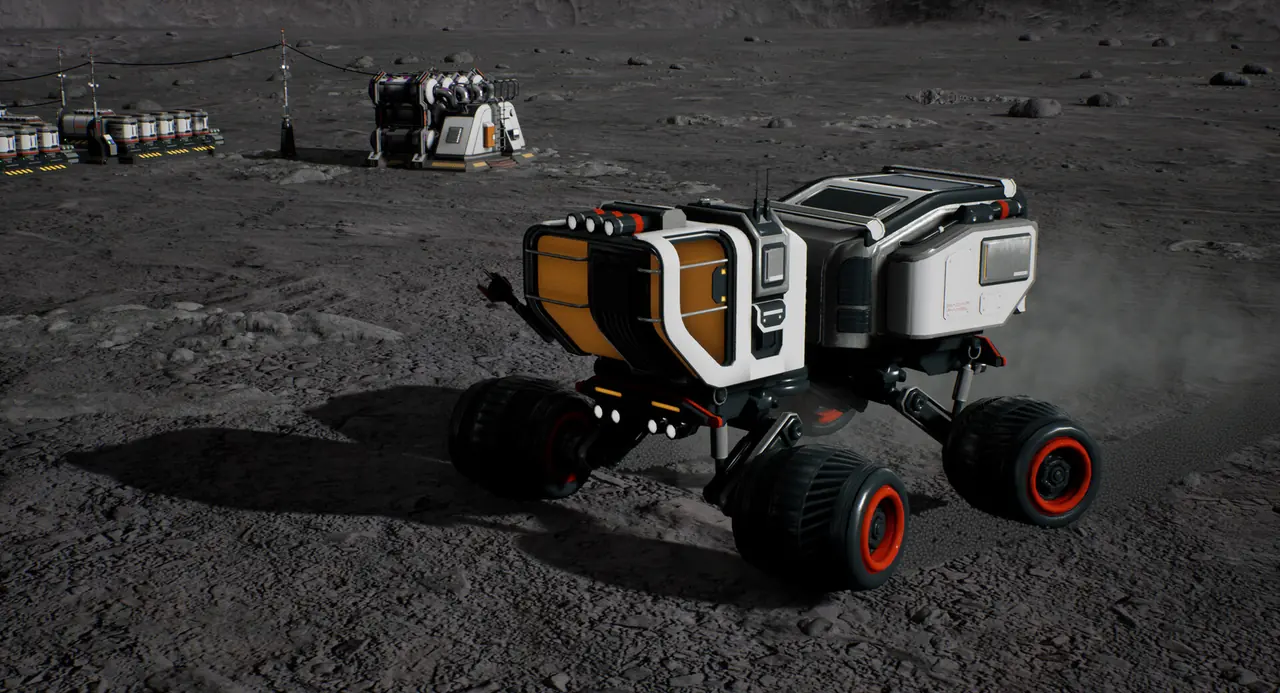
Surface transport in The Crust is a network problem, not a pathing problem. You build roads and the trucks route themselves against them, which means the leverage is in where the roads go rather than in assigning individual vehicles. Everything else follows: split oversized loads across trucks or trips, and remember that since the Big FPS and QoL Update an upgrade is not finished when you research it — applying it costs credits.
- Routing
- AutomaticTrucks pick the shortest route
- Roads
- Speed + safetyKeep trucks off equipment
- Split loads
- SupportedAcross trucks or trips
- Upgrades
- Cost creditsApplied, not automatic
- Upgrade location
- Vehicle interfaceRockets at the Launch Station
- 10 vehicles
- Achievement~12% of players
Trucks route themselves — you build the map
The most consequential design decision in this system is one the developer states in a single line: “Trucks pick the shortest route themselves, taking the nearest road into account.”
That sentence changes what you are optimising. You are not dispatching vehicles; you are maintaining a graph, and the trucks solve against it continuously. Two practical consequences:
Road coverage compounds. Every road you lay to a remote site shortens every future trip to that site. A road that stops one tile short of a mining outpost leaves trucks on unimproved ground for the remaining distance, on every single run, forever.
Roads pay for themselves in saved equipment. When the tool was introduced, the developer framed the problem in their own words: “Have you ever noticed how trucks sometimes drive onto areas that were never meant for them and clip expensive equipment? We decided to put an end to that.” Trucks taking the shortest route across open ground will happily drive through your production block. Roads and parking are what stop that.
So the planning advice is the same as for the base grid: lay roads before the traffic problem exists, not after. Retrofitting a road through a working production block is precisely the scenario the tool was added to prevent.
Splitting loads, and why it matters more than it sounds
An official 1.0 note records improving the routes and expeditions interface and adding “the option to split across several trucks or several trips when there is not enough room in a truck.”
This is a small change with an outsized effect on how you plan deliveries. Before it, a delivery larger than one truck’s capacity had to be broken up by the player — manually, in the right order, without losing any of it. After it, you state the requirement and the game divides it.
The related fix is the one that makes the reasoning obvious: a hotfix records “an issue where a nearly full truck would pick up only part of the resources, causing the remaining resources to disappear along with the point of interest.” Partial pickups silently dropping the remainder is exactly the failure mode a load-splitting system exists to remove. If you played before 1.0 and learned to distrust multi-truck deliveries, that instinct is now obsolete.
The vehicle classes, and where each is built
Official text names the facilities but not the full roster of what belongs where, so here is the split between what is confirmed and what is not.
Confirmed facility names, from official patch notes:
- Small Vehicle Assembly Facility — an official fix concerns “constructing a drone in the Small Vehicle Assembly Facility”, tying the small facility to light units such as drones.
- Large Vehicle Assembly Facility — another fix concerns the Mobile Drilling Rig not continuing construction after the facility was disabled and re-enabled, tying the large facility to heavy machinery.
- Cargo Dock — appears in official text both as a buildable with research costs and as a location that trucks route around.
Confirmed vehicle types, from official text: rovers, cargo trucks, rockets, the Mobile Drilling Rig, the Helium-3 Harvester and the Ice Harvester. The 1.0 announcement also confirms you can now sell MDRs and harvesters and remove outposts — so late-game vehicle management includes disposal, not only acquisition.
What we will not do is publish a table assigning each vehicle to a facility. Official material supports the light/heavy split and names the examples above, but a complete mapping is not published anywhere we could verify.
Getting vehicles and routes into the interface
Several quality-of-life changes in this area are worth knowing because they explain behaviour that used to look like a bug:
| Change | Official wording |
|---|---|
| Free transport units sort first | “Free units not assigned to other modules or routes now appear at the top of their respective lists.” |
| Route from the drilling rig | Added a “Set route” button for trucks in the Mobile Drilling Rig interface. |
| Sorted landing sites | “Added alphabetical sorting to the list of landing sites in the logistics window.” |
| Choosing drones or conveyors | After cargo pods began landing at the Flight Control Center, you “can now freely choose between drones and conveyors for handling deliveries.” |
The last entry is the one worth pausing on. Once cargo pods land at your Flight Control Center, unloading becomes a logistics problem of its own, and the game lets you solve it with either aerial or ground transport. That is a genuine choice with different costs, not a cosmetic toggle.
The mobile-drilling-rig route button is the other one worth noting. It removes a round trip through the general interface: you can assign a truck to a rig’s route from the rig’s own panel, which matters when you are running several extraction sites.
How much transport is enough
The strongest available signal for fleet scale is an achievement. “Lunar Truck Simulator” is awarded for owning at least 10 vehicles, and roughly 12% of players have unlocked it at the time of writing. That tells you two things: a double-digit fleet is a normal mid-game state rather than an extreme goal, and most players have not reached it yet — so transport is one of the systems that scales later than production.
A practical sequence:
| Stage | Transport focus | Because |
|---|---|---|
| Early | One truck, short trips inside the base footprint | Roads are a research cost you may not want to pay yet |
| Early-mid | Roads to the first remote extraction site | Coverage compounds on every future trip, so early roads pay twice |
| Mid | Split-load deliveries to remote outposts | Single-truck capacity becomes the bottleneck before vehicle count does |
| Mid-late | Upgrade the fleet, paying credits per vehicle | Research alone does not apply the upgrade |
| Late | Sell redundant MDRs and harvesters as sites close | Disposal is supported and recovers value from obsolete equipment |
What this page does not claim. No vehicle capacities, no travel times, no per-upgrade credit costs, and no vehicle-to-facility mapping beyond the light/heavy split that official notes demonstrate. The routing rule, the split-load feature and the credit cost of upgrades are all quoted directly from official text; anything resembling a stat table would have to be invented, and inventing it is what this site exists not to do.