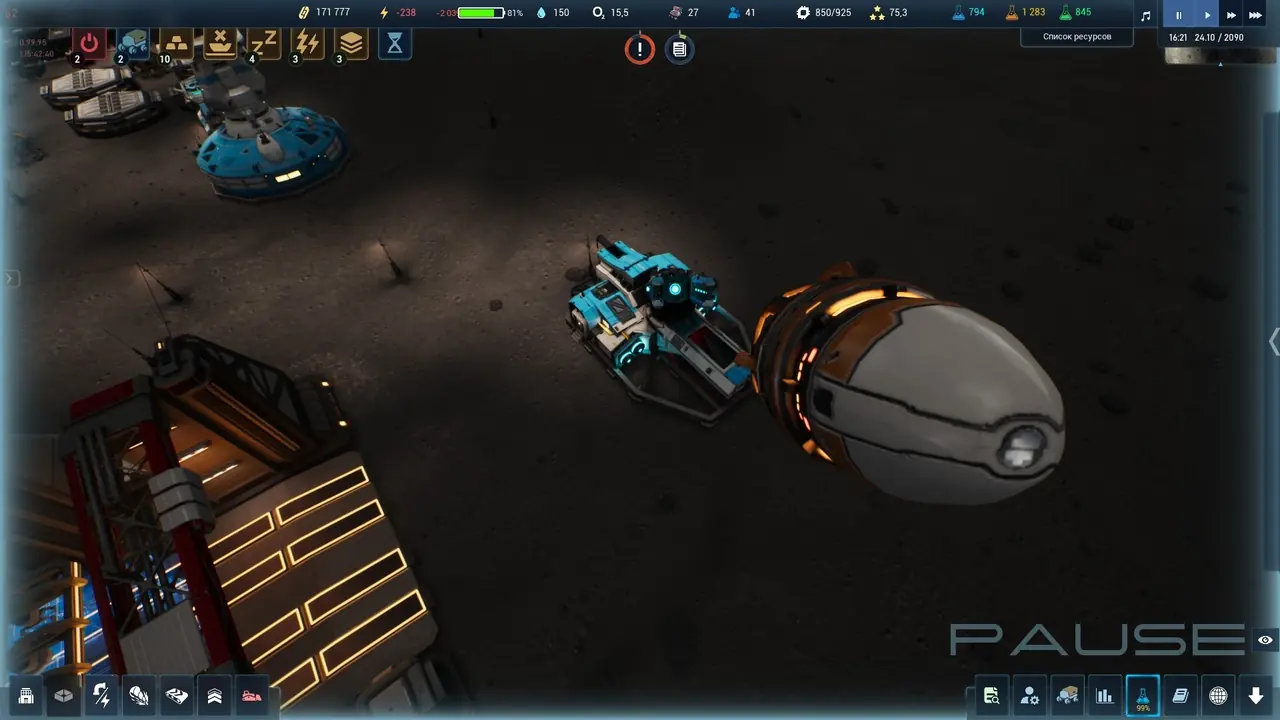
An expedition is the game asking a logistics question with a timer attached: can you get the right vehicles, the right crew and the right cargo to a place on the Moon before the window closes? The two failures people actually hit are assembling a crew the game does not count as assigned, and sending one overloaded truck when the interface expects you to split the load. Both have official fixes and official explanations. The system itself is gated behind one building, and that building is gated behind research.
- Gate
- Control CenterBehind its own research
- Crew types
- Trucks + dronesSome sites demand drones
- Capacity
- SplittableSince 1.0
- Sorting
- In the windowSince 0.99.90
- Scouting
- RoverResolves unknown markers
- Rarest goal
- 7.5%Rescue all Hope-2
The building everything depends on
There is no expedition system until you have the Expedition Control Center, and there is no Expedition Control Center until you have researched two things. Its research node lays the chain out as metadata: the Landing Platform research is the prerequisite, and the Flight Control Center is what it unlocks.
That is a meaningful ordering, because the Landing Platform is not a formality — the community wiki describes it as the thing that makes commercial work legal: “according to CRUST regulations, the presence of a landing platform or its equivalent is necessary for commercial contracts.” So the sequence the developers built is: you become a legitimate trading entity, then you gain the ability to reach out across the Moon, then you gain flight control. Expeditions are the middle link of a logistics spine, not a side activity.
What the Control Center itself gives you is described more usefully in its research text than anywhere else:
“…the main module to coordinate expeditions and contracts on the global map. Sets up expeditions, increases the number of communication channels.”
The community wiki's module page describes it as coordinating "research missions outside the base," ensuring "communication with research groups, allowing the dispatch of transport vehicles with drones or colonists to remote lunar locations."
It also contains the clearest statement anywhere of what the module is physically: an array of radio equipment and servers, with route planning, monitoring and data analysis automated.
That page is tagged to a build well before 1.0, so use it for what the module is, not for what it costs. Its category — Logistics — is worth noting, because it means the Control Center competes for the same build space as your cargo and storage modules.
Source: thecrust.wiki.gg community wiki, Expedition Control Center page, tagged version 0.99.55. Community tier.
What actually goes on an expedition
This is the part the game does not spell out in one place, and the community’s cargo truck page is the clearest source: trucks on an expedition carry resources, drones and colonists. All three, in one vehicle.
That single fact reorganises how you should plan. An expedition is not “send a truck with stuff” — it is a small combined-arms deployment, and the composition has to match what the site expects.
The sites themselves set the requirements, and they are not interchangeable:
- Drone-only sites. Several catalogued locations list a requirement of two drones sent via the Expedition Control Center. A colonist crew is not an alternative to drones here; it is the wrong answer.
- Crewed sites. Others want professions with levels — one site’s full-option branch asks for two engineers and a medic alongside drones and components.
- Choice sites. Some ask you to pick an approach, and the branches pay differently. One vehicle-investigation site offers three options including reporting the find to CRUST or walking away, and only the first returns a Control Unit.
The community also groups expeditions into four difficulty bands on a page tagged to build 1.0.6.1 — “walk in the park”, “challenge”, “test of strength” and “epic story.” We will not reproduce that page’s reward tables, because they are measurements from one build, but the vocabulary is worth adopting: it is the community’s attempt to give you a rough sense of what a marker is asking for before you commit.
The loadout is the decision; the travel is not. Nothing in the official patch history suggests expeditions fail because the trip itself is hard. Every documented failure is about composition — drones not loaded, a colonist not counted as assigned, a truck without room. Read the site's requirement, then build the convoy to match it, then send it.
Splitting a load: the interface change that matters most
If you take one operational fact from this page, make it this one. The 1.0 release notes contain a line that solves the most common bulk-transfer problem in the game:
“Improved routes and expeditions interface. Added the option to split across several trucks or several trips when there is not enough room in a truck.”
Before this, a load that did not fit was a load that did not go. Now the interface will distribute it — either across more vehicles or across more trips with the same vehicle. The distinction between those two options is the one worth internalising, because they trade off against different things: more trucks costs you hardware, more trips costs you time, and expedition work is usually under a timer.
The community’s advice on cargo trucks converges on the same conclusion from the other direction, recommending that for larger jobs you explicitly assign smaller amounts and “create multiple expeditions with multiple Cargo Trucks to satisfy such contracts within their time limits.”
Two smaller interface improvements in the same area are worth knowing because they make the window usable: Update 0.99.90 “Added sorting when selecting transport in the expeditions window,” and the June balance update fixed “incorrect icon display in the description and interface of expeditions” — which is the kind of bug that makes you think you selected the wrong vehicle when you did not.
Automation, and the one research to look for
Expeditions sit inside the game’s broader automation trajectory. Update 3 listed “Automation of contracts, expeditions, and unit production” among its headline features, and it added storage displays specifically in the buildings that matter for this loop — including, in the announcement’s words, the internal storage display in the “Flight Control Center, Expedition Center, and Launch Station.” Note again the shorter building name there; the module’s own research calls it the Expedition Control Center.
The specific research worth hunting for is the one attached to Multi-Storage. Update 3 describes it as research that “enables automatic resource supply for contracts and expeditions,” and adds: “Once connected to certain modules, it will automatically open outputs and provide the exact amount of resources required.”
That is the difference between loading an expedition by hand and letting the base prepare it. If expeditions are a recurring chore rather than an occasional decision, this is the research that changes that.
The documented bugs that look like your mistakes
Four official fixes describe expedition problems from the player’s side, and each one is worth recognising because in every case the game’s presentation was the problem, not your planning.
| Symptom | What was actually wrong |
|---|---|
| A truck looks crewed but will not depart | Colonists sitting in a truck but not assigned to an expedition were missing from the personnel list (fixed in Hotfix 1.0.11) |
| A colonist cannot be sent on any run | A colonist could not be sent on an expedition after visiting a point of interest (fixed in Update 3) |
| A colonist comes home unkillable | A colonist retained invulnerability after a cancelled expedition (fixed in the Big FPS and QoL Update) |
| Crew missing from the list after a quest run | Two colonists could fail to return from an expedition in the Black Obelisk quest while remaining in the colonist list (fixed in Update 0.99.87) |
There is also a fix that predates all of them and is worth filing away for the opposite reason: Patch 0.99.78 “Fixed an issue where drones were not loaded onto expeditions.” If drones are part of your loadout and the run then behaves as though they were not, that is a failure mode with official precedent.
Notice what these have in common. Not one of them is about the expedition being too difficult or the rewards being wrong. Every single one is a UI or state-tracking defect. That is a useful prior when something goes wrong on a run: assume the interface is lying to you before you assume your plan was bad.
Rovers: the reason a marker is a question mark
The final piece is the vehicle that makes expeditions possible in the first place, and it answers a question the map raises immediately — why are some sites shown as question marks?
Because they have not been scanned. The community wiki’s description of the Rover Scout is direct about this: it is “used to scan unscanned expedition sites (Question marks on the global map),” and it can also reveal sites you would not otherwise see at all by using a “Locate hidden objects” mode in the rover’s own menu.
The rover does more than scout. The research that equips it with a geological scanner describes the outcome as “the creation of a resource map of the Moon’s surface,” which “helps determine mining sites for the Mobile Bore Unit.” So the same vehicle that resolves your question marks is the one that tells you where to point a drilling rig — which is why the rover usually pays for itself before a single expedition departs.
What this page does not claim. No expedition durations, no travel distances, no reward quantities, no crew-size rules and no per-site tables. Reward values were re-tuned repeatedly, the difficulty bands are community measurements from a single build, and the only figures this page quotes are achievement completion rates and the specific balance changes the developers published. What is documented: expeditions require a researched Control Center, carry trucks and drones and colonists together, split across vehicles or trips since 1.0, are sometimes gated on drone-only composition, are scouted by rovers, and failed for a documented list of interface reasons rather than difficulty reasons.