The Crust's economy has two numbers that players routinely confuse. Market price is what a resource is worth right now, it updates dynamically, and it can be inspected per resource. Base capitalisation is your leaderboard score — the value of what you have built — and it is not market-driven at all, despite the search term "market capitalisation" being widely used. Knowing which of the two you are trying to increase changes what you should build: price is about timing your trades, capitalisation is about accumulating and keeping structures.
- Credits display
- Top barWith production rates
- Leaderboard stat
- Base capitalisationNot "market"
- Capitalisation debit
- Demolition countsConveyors included
- Auto-trade cap
- 5 goodsPer Flight Control Center
- Price updates
- DynamicallyInspect before trading
- Exploits
- 2 closedDo not chase them
The stat is “base capitalisation”, and it is not driven by the market
This is the terminology correction that matters most on this page, because the search term people use does not exist in the game’s own vocabulary.
A search across the entire official announcement history for app 1465470 — all 147 posts — returns zero hits for “market capitalization.” The phrase the developers use is different:
Detailed player statistics are now recorded in an online leaderboard across several indicators: base capitalization, capitalization growth rate, and other metrics.
So the game tracks base capitalisation and its growth rate. The word “market” appears 17 times in the announcement history, but never as a modifier for capitalisation.
Why does the distinction matter practically? Because it changes what you optimise for. A market capitalisation implies a market is valuing you — that buyers and sellers collectively price your holdings, and that your score moves for reasons outside your control. Base capitalisation is a straightforward valuation of what you own, and the developers have confirmed exactly that by describing what they add to it.
What gets added to capitalisation, and what gets subtracted
The composition of the score has been adjusted twice, and both additions are the kind of thing a player would not guess.
Residential construction costs count. From the 0.99.85 change list: “Added residential construction costs to the base capitalization calculation.” Housing was previously excluded, which meant a player could build an enormous habitat block and see no change in their score.
Outpost resource value counts. From Update 3: “Outpost resource value is now included in total capitalization.” This is the more consequential of the two, because it makes off-site expansion score-visible. Before that change, resources extracted at an outpost and left there may as well not have existed for leaderboard purposes.
And one subtraction, which is confirmed only because it used to be broken:
Fixed an issue where demolishing conveyors did not reduce base capitalization.
That fix establishes the direction of the mechanic. Demolition is supposed to lower your score, which means capitalisation is a live valuation rather than a high-water mark. Practically: you cannot build, demolish and keep the score, and a base you gutted no longer reads as a base you built.
The pattern across all three entries is that capitalisation tracks what is present, including structures, housing, stored resources and off-site holdings. That makes it an accumulation score rather than a trading score — which is precisely the opposite of what the term “market capitalisation” would lead you to expect.
Market price is a live number, and you can inspect it before you commit
The pricing system is genuinely dynamic, and the developers built the interface around the assumption that you will need to check.
The core mechanic, from the 0.99.85 notes:
When setting up auto-trading, it can be difficult to choose a price that is both profitable and attractive to buyers or sellers. To simplify this, we’ve added the option to trade resources at market price, which updates dynamically while searching for deals.
Three features follow, all in 1.0:
The price is inspectable. “hovering over a resource shows its market price.” You do not have to commit to a trade to learn what the good is worth.
Auto-trade has a per-building cap. “You can now put up to 5 goods up for trade on a single Flight Control Center.” That is a layout constraint worth planning around — if you want more than five goods trading simultaneously, you need more than one Flight Control Center, and the buildings consume space and CPU.
Auto-buy and auto-sell were improved as a pair. The notes group them: “Improved Auto-Purchase and Auto-Sell modes.” Auto-purchase became a first-class feature earlier, in Update 3, alongside “a Transport menu with a full list of the player’s vehicles.”
The word to hold onto is dynamically. A player who checks a price, plans a large sale, and then executes it minutes later is trading against a number that has moved. That is not a flaw — it is the design.
Prices move on two timescales, and both are documented
Understanding that official balance patches change base market prices is what separates a current money strategy from an expired one.
Here is the June 2026 rebalance, quoted exactly:
- “Base market price of steel and silicon reduced by $5.”
- “Base market price of titanium reduced by $10.”
- “Base market price of aluminum reduced by $15.”
- “Base market price of smart concrete increased by $10.”
- “Rebalanced market prices of parts and microprocessors.”
Two observations. First, the phrase “base market price” implies a reference value that fluctuation moves around — so the $5 and $10 figures are baselines, not the prices you will see. Second, four of the five changes moved prices down, and the one increase was on a finished building material. That is a deliberately deflationary adjustment on raw inputs, which raises the relative value of processing over selling ore.
The short-term timescale is documented through its failures, which is typical for economy systems:
| Version | Documented behaviour |
|---|---|
| 0.99.85.3 | “market prices could sometimes drop to zero” |
| 06-11 balance | “market resource prices could freeze at a single price for 6 days” |
| 0.99.87 | “loading a save updated the market” |
| Update 3 | “Increased resource scrolling speed in the market” |
The second entry is the informative one. A fix for prices freezing “at a single price for 6 days” tells you the intended behaviour is continuous movement — the bug was the absence of fluctuation. So a market that looks static is a market that is malfunctioning, and the correct response on an older build is a patch rather than a strategy.
The legitimate routes to credits
Official sources name six distinct credit sources, and they are worth listing because three of them are easy to overlook.
Contracts, including early completion bonuses. A 0.99.87 change confirms the bonus exists as a mechanic: “The early contract completion reward field now shows percentage ranges instead of exact numbers.” The AI trade analyst research then automates the evaluation: it “automatically calculates a contract’s potential profit against current market prices for resources and also ensures the maximum reward for its early completion.”
Auto-sell, with the market-price option described above.
Barter, which trades goods rather than paying credits directly.
Data Processing Node income, added to the statistics interface: “Added income from the Data Processing Node to the Income & Expenses tab in statistics.” The existence of a dedicated Income & Expenses tab is itself worth knowing — it is where you audit which of these routes is actually paying.
Converting science points into credits, via repeatable research: “Added repeatable research for converting science points into credits.” This is the answer to a surplus science economy, and it is repeatable, which makes it a throughput route rather than a one-off.
The Financial loan system, listed among the systems added during Early Access.
Two other purchases belong on this list as context rather than income: the notes record that “Applying researched upgrades to rovers, cargo trucks, and rockets now requires credits,” and the CRUST Solutions store sells vehicles outright — Hotfix 1.0.10 fixed “an issue where the Truck could not be purchased from the CRUST Solutions store despite having enough credits.” So credits buy capability directly, not only through the construction menu.
The two money exploits, and why we are not documenting them
Both are closed, and we are naming them only so that a guide you find elsewhere cannot sell you one as current.
Auto-sell without shipping. Patch 0.99.88.4: “Fixed an exploit in the auto-sell mechanic that allowed credits to be gained without sending resources.”
Infinite credits via Conveyor Elevator and Gas Storage. From the 0.99.85 fix list: “Fixed an issue allowing infinite credits using the Conveyor Elevator and Gas Storage.”
We have deliberately omitted reproduction steps. They would not work on a patched build, and a guide that spends its word count on a closed exploit is a guide that has not been updated. What replaced them is legitimate and repeatable: the science-to-credits research conversion, which is designed to be run indefinitely.
Reading the economy from the HUD
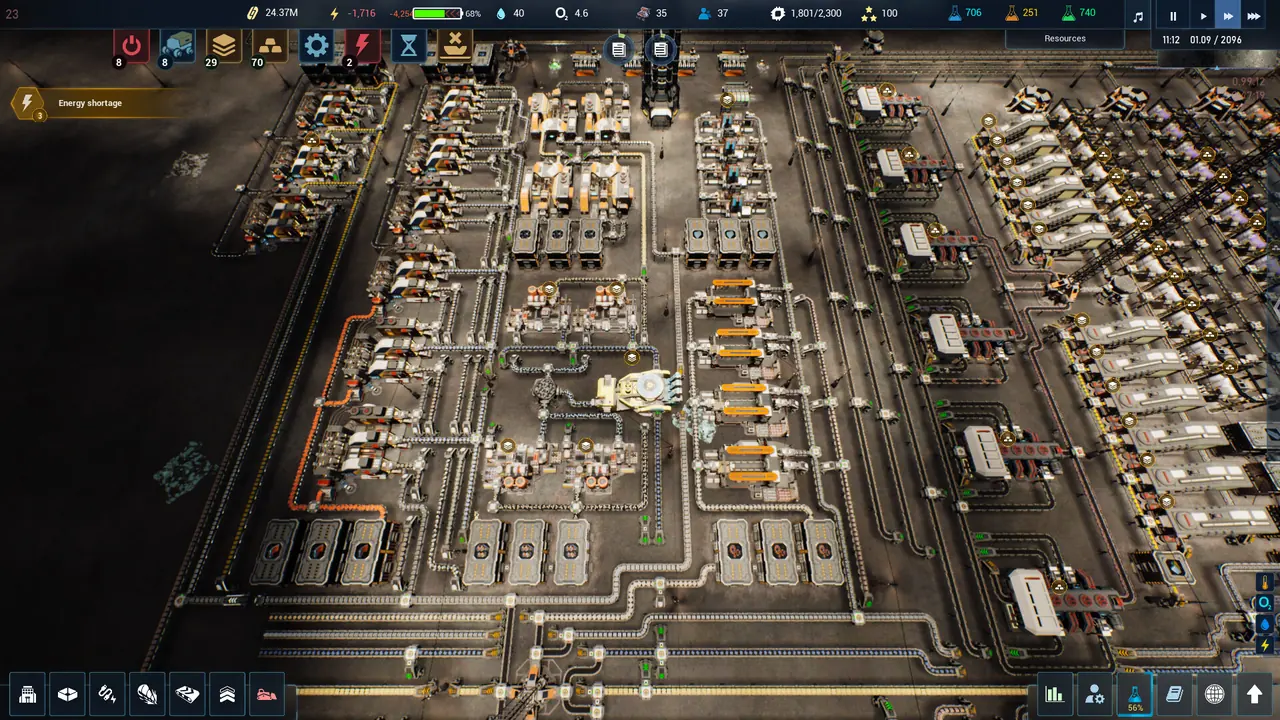
The interface at the top of the screenshot is where all of this resolves, and it is more informative than it looks.
The cluster on the left is credits — a total, expressed in millions once your base is developed, with a per-period delta. To its right sits a run of resource readouts, each pairing an icon with a current amount and, in several cases, a rate of change. The gameplay view underneath is a mature production district: conveyor lines threading between machine blocks, which is what the credits figure is actually made of.
The panel on the left edge is the part that connects this page to the rest of the site: a warning reading “Energy shortage.” It is worth dwelling on, because it is the single most expensive failure mode in the game’s economy. An energy shortage does not just reduce output — it stalls the production chain that generates the resources you are selling, which is why the power page treats headroom as an economic decision rather than an engineering one.
Trade, capitalisation and the story
One final connection, because it is the piece that ties the economy to the campaign. The 0.99.85 cycle includes this line among its organisation changes: “How many Organizations will help with building the laser cannon and the interstellar ship, and to what extent, now depends on reputation.”
Reputation is not a currency you spend. But it is the thing that converts everything on this page into construction aid on the two late projects — which means the economy and the endgame are the same system viewed from two ends.
Two numbers, two different games
If you want the leaderboard number up, you are playing an accumulation game: build, keep, and expand to outposts, because capitalisation counts housing, structures and off-site resource value, and it falls when you demolish. If you want credits up, you are playing a timing game: watch market price, sell into strength, finish contracts early for the percentage bonus, and park surplus science into the repeatable credits conversion. Trying to raise both with one strategy is why so many colonies look wealthy and score poorly.
Where this leaves you
Four things to carry forward. The stat is base capitalisation, not market capitalisation, and it is a valuation of what you have built. Market price is dynamic and inspectable — check it rather than assuming it. Base prices get rebalanced by patch, so a price guide from an earlier version is describing a different economy. And the two money exploits are closed, which makes the repeatable science-to-credits research the only unbounded income route the developers actually shipped.
None of these are hidden. They are all in the patch notes, stated plainly, and in most cases stated as a fix to something that was working wrongly. That is the pattern across this whole site: the announcement history is a better mechanic reference than it looks — you just have to read the bugs as descriptions of intent.