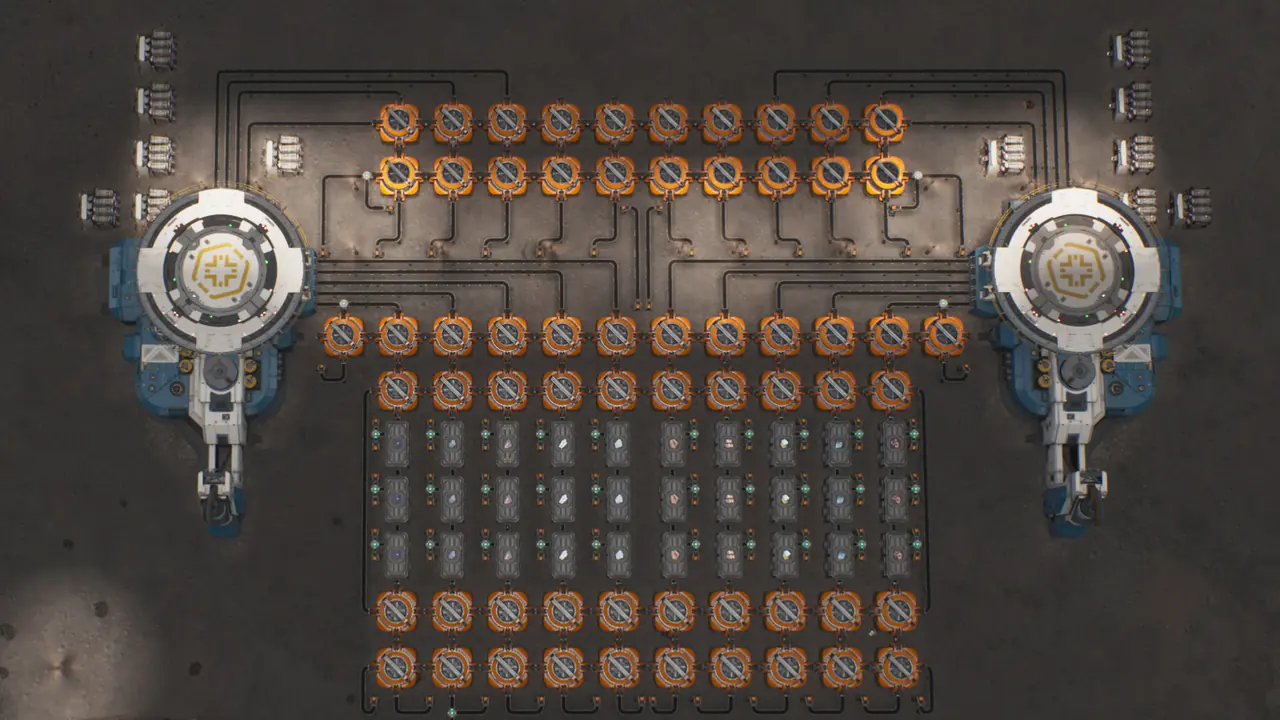
Power in The Crust is a grid problem, not a building problem. Generation comes in two families — sunlight-dependent and sunlight-independent — and the whole difficulty of the system is the gap between them: the lunar night. What changed in 1.0 is that the game stopped letting that gap kill you in the first week, added a Solar Flare rework that makes underground battery storage genuinely valuable, and made wire runs behave. Learn three things — which of the two families your base leans on, where your storage physically sits, and how to read the "Not enough power to run the module" warning — and the power system stops being a recurring emergency.
- Menu name
- ElectricityBuild-menu category
- Two families
- Sun-dependentvs. sun-independent
- Storage
- Battery bankUnderground since 1.0.9
- Grid wiring
- Wires and polesSnap within one tile
- Flare risk
- Surface onlyAfter the 1.0 rework
- Failure text
- Not enough powerPer-module warning
Start with what the game calls things
Most power guides open with ratios. That is the wrong end of the problem, because a ratio you misapply is worse than no ratio at all — and the first place players go wrong is using names the game does not use. The Electricity build menu, as it appears on the official Steam store screenshot, lists its buildings by these names:
| In the build menu | What it is |
|---|---|
| Wires | The connection layer between generation, storage and consumers |
| Charging station | Where vehicles top up |
| Battery | Standard grid storage |
| Large accumulator battery | The larger storage block |
| Electric Pillar | The pole that distributes power across a span |
| Small / Medium / Large solar panel | The sun-dependent family |
| Small Fuel Generator | A sun-independent generator |
Two of those names are worth pausing on. Electric Pillar is the object that wires snap to, and in Update 1.0.12 it received a research option that “increases the number of connections for an Electric Pillar to 6 and increases its maximum radius.” That is a research that quietly buys you grid coverage without buying you generation — it is the cheapest way to fix a base whose problem is reach rather than watts.
The second is the accumulator in “Large accumulator battery”. Accumulators are a real electrical idea: a device that stores charge and releases it on demand. The menu is telling you something about how the developers think about storage — it is a buffer you ride through the night on, not a generator you lean on permanently.
The eight names in that table are transcribed from the official Steam store screenshot of the build menu with the Electricity category open, showing Wires, Charging station, Battery, Large accumulator battery, Electric Pillar, Small solar panel, Medium solar panel, Large solar panel and Small Fuel Generator.
That screenshot is why this page uses "Small Fuel Generator" where the patch notes simply say "Fuel Generator". The patch notes are talking about the same machine; the menu is the place a player has to find it. When an interface label and a changelog disagree, the interface is the one you have to navigate.
Source: official Steam store screenshots for app 1465470, read 22 September 2026. Interface text is quoted exactly as rendered.
The two families, and the night between them
The developers group generation by a single question: does it need the sun?
Sun-dependent generation — the solar panel line — has the property that matters most in a game set on the Moon, which is that it produces nothing for roughly half of every cycle. That is not a flaw; it is the design. It means solar is cheap to run and expensive to rely on, because every watt you intend to use at night has to have been stored first.
Sun-independent generation is everything else, and this is where The Crust’s production chain reaches into its power system. The two generators the developers chose to name in the 1.0 feature list — the Thermonuclear Generator and the Biogenerator — both sit on the consuming side of other systems: one of them burns a fuel you have to manufacture, the other burns organic input. An official patch note even adds research “for the Biogenerator and Thermonuclear Generator to reduce organic and energy cell consumption,” which confirms the shape of the deal: these machines trade a resource chain for continuous output.
A third generator family exists at the low end — the RTG, which appears in official notes about outposts — and the Fusion Reactor, whose upgrades were added in a spring update. Between them these are the machines you graduate to when you get tired of planning your base around the sunrise.
The real question is not "which generator is best". It is "which half of my base must survive the night". Habitation, life support and anything with a thermal requirement cannot pause for fourteen days of darkness; a smelter can. Splitting your grid mentally into must-run and may-pause loads is what makes the storage number tractable — and it is the reason two players with identical bases can need wildly different battery banks.
The first lunar night: the wall that 1.0 removed
If you have read older write-ups of this game, you have seen the complaint that a new colony can die on its very first night. That complaint was accurate once and is now historical, and the way the developers fixed it is more instructive than the fix itself. An official balance note reads, in full:
“Eliminated situations where you’d run out of power on the very first lunar night.”
Read what that sentence does not say. It does not say the first night is now easy, or that storage is no longer needed. It says the situations in which you could not survive it have been removed. The distinction matters: the game removed a failure you had no counterplay against, and kept the one you do.
If you are still brownout-ing early, the balance update also tells you where to look. In the same patch the developers raised the output of the smallest panels — “Small solar panels: generation increased 28->30” and “Medium solar panels: generation increased 70->75” — while raising what a refinery draws: “Regolith Refinery: power consumption increased 6->8.”
That pairing is the whole early-game power story in two lines. Generation went up; the industrial load went up more. A base that grows into refining should expect its power situation to get harder before it gets easier, not easier, because the machines you unlock are hungrier than the machines that unlock them.
Every figure in the section above — 28 to 30, 70 to 75, 6 to 8 — is from an official balance update dated 11 June 2026 and is almost certainly not the number you will see on screen today, because the game has been hotfixed repeatedly since.
We quote them anyway, for one reason: they prove that the numbers move. A guide that hands you a table of generation values without a date is telling you something that was true on an unknown day. What does not move is the structure — panels stop at night, storage covers the gap, industry raises the load — and that structure is what a guide can honestly give you.
Treat any specific wattage you read online, including on this site, as a starting hypothesis to check against your own module tooltips.
Source: official Balance and QoL Update, 11 June 2026, app 1465470. Figures are historical and labelled as such.
Solar Flare: a gamble, and a rework that changed where you keep batteries
The Solar Flare is the event that makes the power system interesting, and the developers described it with unusual candour in the 1.0 announcement:
“This event occurs randomly and can either trigger increased power output from your solar panels (but that’s not certain =)) or damage your buildings and the colonists working at their posts on the surface.”
Three things are packed into that sentence. It is random. It is not reliably positive — the developers put a smiley next to “that’s not certain”, which is the tone of people who know they are describing a troll. And its downside targets the surface, specifically buildings and the colonists standing on them.
The 1.0-series hotfixes then changed the event. Hotfix 1.0.8 improved the timer display, and Hotfix 1.0.9 delivered the substantive change:
“Reworked the Solar Flare event. Batteries located underground are no longer drained by it.”
This is the single most actionable power fact in the modern game, and it is easy to read past. Before the rework, a flare could reach your reserve wherever it was — which meant the event could take away not just your generation but the buffer you were relying on to survive the night after it. After the rework, storage placed underground is outside its reach.
Combined with the earlier note that a base can hit the “not enough power to run the module” state module by module, the strategic read is straightforward: the flare punishes surface exposure, so move what you can underground. Your panels have to stay up. Your batteries no longer do.
Two smaller official changes belong with this one, because together they show the event being tuned rather than removed. An official note records “Improved the timer display during a Solar Flare,” and another records a fix where “the incoming meteorite notification and Solar Flare timer disappeared after loading a save.” If you load an old save mid-event and the timer is gone, that is a known, patched behaviour — not a sign you misread the screen.
Reading the warning the game actually gives you
When a module has no power, The Crust does not ask you to guess. The interface puts a warning in the corner: “Not enough power to run the module.”
That wording is precise in a way worth respecting. It does not say your grid is down. It says a module cannot run. Those are different failures with different fixes, and the phrase steers you toward the cheaper explanation first:
- Is the module connected? Not “is there power” — connected. An official fix records modules that “would not connect to the power grid” in some cases, and another addresses modules in living quarters that “wouldn’t detect available electricity.” A grid can be healthy while a single module sits outside it.
- Is the wire run actually a wire run? The developers added “snapping of wires and pipes to poles within a one-tile radius” specifically because — in their words — “players often misclicked and accidentally placed a power pole hologram instead of connecting a wire to an existing pole.” Long hand-drawn runs are where this bites, and the fix came with a removal tool that deletes both poles and the connections between them.
- Only then, is it a shortfall? If connections are sound, you are looking at demand exceeding supply, and the answer is in the generation family you chose and the storage you built for it.
There is a second warning worth knowing by name. An official note adds “a tooltip about energy shortages in the Flight Control Center when in auto-trade mode” — a reminder that automated trade has a power cost, and that the game will tell you so rather than let a trade route silently starve.
What to build, in the order that survives patches
| Step | Do this | The reason, in official terms |
|---|---|---|
| 1 | Cover the base with panels and a battery bank before you industrialise | Storage capacity, not panel count, is what carries you to sunrise |
| 2 | Keep the first battery bank near your core, and plan to bury the expansion | Underground batteries are exempt from Solar Flares since Hotfix 1.0.9 |
| 3 | Add an Electric Pillar connection research when reach, not output, is the problem | 1.0.12 raises pillar connections to 6 and enlarges their radius |
| 4 | Split must-run loads from may-pause loads before adding industry | Refining raises draw — an official patch raised the refinery from 6 to 8 |
| 5 | Move to sun-independent generation before you scale production | Generators trade a supply chain for continuous output; solar trades free output for the night |
| 6 | Snapshot your module tooltips after every patch | Balance figures move; the module interface is the only current source |
What this page does not claim. No wattage tables, no module-by-module consumption list, and no fixed solar-to-battery ratio. The community wiki's own Power System page leaves its ratio table empty — every cell reading N/A — precisely because the relationship could not be confirmed, and its remaining figures have since been overtaken by official patches. Any ratio you build from is a measurement of your own base, not a constant you can copy.