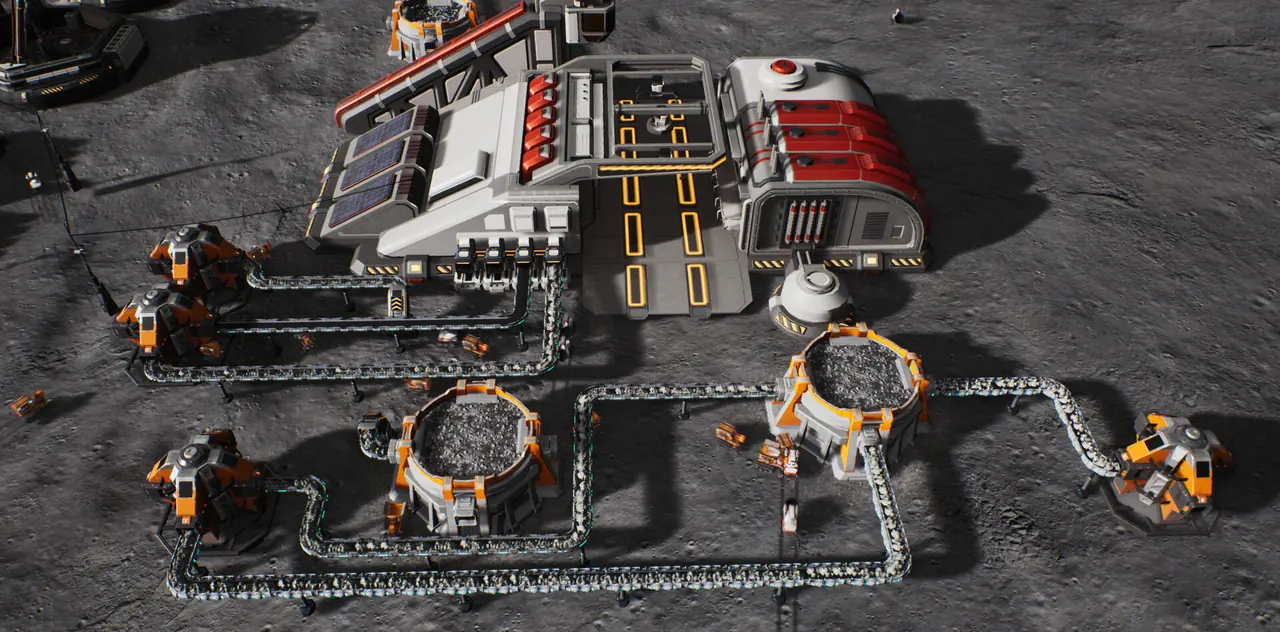
Mining in The Crust happens in two places that feel like two different games: you excavate rock underground, which yields regolith and eventually runs into basalt, and you work surface deposits and veins, which the game highlights for you and which each have their own extractor type. The single most useful thing to know before you plan is that placement is now a solved problem — since 1.0 the interface marks the vein cells that will accept a building. The second is that your yield depends on which vein the rock came from, so no published throughput figure is a promise.
- Two fronts
- Underground + surfaceDifferent tools entirely
- Placement
- Cells highlightedSince 1.0
- Gas overlay
- Ctrl keyAlso in build mode
- Yield
- Vein-dependentCommunity "richness"
- Depletion
- PermanentAn achievement tracks it
- Rigs
- SellableAnd meant to stay put
Two fronts, two different problems
The confusion most new players have about mining is not about resources; it is about which of two unrelated systems they are looking at.
Underground excavation is about rock. You dig walls, and the dug material is regolith that has to be collected. The 1.0 release reworked the look of all of this — “New visual style for excavated walls,” “New visuals for regolith rocks dropping from excavated walls,” “New visuals for basalt in walls” — and the announced feature set lists a “New excavation algorithm” alongside a fully reworked visual pass across “excavated walls, basalt and regolith.”
That naming is worth reading carefully, because it establishes that basalt is a distinct material from regolith, not a texture variant. Basalt also has its own research line: an official balance note “Rebalanced the basalt-drilling research,” and updates to the mining interface reference basalt separately from regolith. If you have hit rock that your diggers will not take, the material’s identity is the thing to check, which is why players search for “hard rock drilling” by name.
Underground excavation also constrains everything else you build. An official note records adding notifications for “when a room cannot be built because it contains unexcavated regolith,” and a separate fix records rooms being constructible “around unexcavated regolith” as a bug. Excavation is a prerequisite for building, and it is also a resource stream — the two are the same action.
Surface mining is about deposits and veins. It uses dedicated modules, it has its own placement rules, and it is where the mineral variety lives: the community wiki’s resource list puts the mining-produced materials as regolith, water ice, titanium oxide, iron oxide, silicon oxide, aluminium oxide, rare earth minerals, slag, helium-3, argon, methane and neon.
Excavation is the cheapest resource in the game, and the most permanent decision. Every cell you dig is a cell that has been removed — it cannot be un-dug, and it changes which rooms you can place later. That is why Planning Mode matters more for underground work than for surface work: on the surface you can move a module, and underground you cannot move the rock back.
Placing an extractor: the game now tells you
If you take one operational fact from this page, make it this one. The 1.0 announcement states that the mining interface “now highlights vein cells suitable for construction, making it easy to place extractors.”
That single line replaces a large amount of guesswork. Before it, placement was a matter of reading deposit art and learning by failure — and because the eligible cells are not the same as the cells that look resource-rich, players consistently built in the wrong square. Now the interface answers the question directly.
Two related interface additions from the same era are worth knowing because they serve the same purpose — making the map legible:
- Gas is a separate overlay. An official patch added “gas icons above deposits on the base. They are visible when holding Ctrl and in Construction mode.” If you cannot see the gas on your map, you are not holding the right key.
- Underground connections are highlighted. Official notes record adding path highlighting and highlighting for connected underground conveyors, so you can see what an underground run actually links.
And a third, which changes how you look at a fresh map: an official hotfix “Increased the radius of generated resource veins.” Veins are generated larger than they once were, which matters when you are deciding where to start a base — a bigger vein is a longer-lived one.
What “richness” means, and why it makes every table conditional
The most-searched mining phrase in this game is “regolith richness”, and it is worth being precise: it is not official vocabulary. A full-text search of the official announcement and patch-note history returns no use of the word. It comes from the community wiki, which uses it to describe how much of a target ore a given batch of regolith contains.
The reason it matters anyway is what the community did with it. The wiki’s refinery production tables are explicitly written as base production “assuming the input Regolith has a richness of 100% of the target ore.” That is a condition, not a typical value.
Which leads to the honest conclusion about mining yields: a refinery fed from one vein will not match a table written for another, because the rock’s chemistry depends on where it came from. This is also why the Single Regolith Refinery can only produce one oxide type at a time — the input determines the output, and the module cannot blend its way around that.
We searched the complete official announcement and patch-note history for app 1465470 and found no instance of "richness". It is community vocabulary, and we are flagging that because it changes how you should use it.
Used as a concept — different veins give different yields per unit of regolith — it is supported by everything the game does: the refinery's one-oxide-at-a-time design, the separate oxide types, and the existence of extractor upgrades that change throughput.
Used as a number — "this vein has 100% richness" — it is a community convention measured under conditions the wiki states but cannot generalise. Treat any yield figure you read, here or elsewhere, as conditional on a vein you have not tested yet.
Source: thecrust.wiki.gg community wiki, refinery production pages, tagged version 0.99.55. Community tier.
Gas is treated as a category, not a material
Gas mining behaves differently enough to deserve its own mental model, and the patch history makes the difference plain: whenever the developers touched gas, they touched all of it at once.
- “Increased the capacity of all gas veins on the base by 40–100%.”
- “Increased the gas volume of Argon, Neon, and Methane veins on the base map by 20–30%.”
- “Increased the chance of Argon and Neon veins spawning on the base map.”
- “Reduced the cost of Outpost Gas Extractor upgrades by 50%” and “Increased the efficiency of Outpost Gas Extractors from 10% to 15%.”
- “Increased the Gas Extractor’s power consumption: 12 → 22.”
Four separate updates, all treating “gas” as one lever. That is a strong signal about how the designers model it: gas is a family with shared economics, not three unrelated materials.
The one figure in that list worth pausing on is the extractor’s power draw, which was raised substantially. Extraction is not a cheap load, and gas extraction in particular became more expensive to run in the same period that its yields went up. If you are planning a gas expansion, plan the power for it as well — and remember that the actual current value is the one on your own module tooltip.
There is also a failure mode specific to story content: an official note “Reduced the failure chance of the gas extractor in the Echo-7 quest by 50%,” and another changed “the colonist profession requirement in the Gas Extractor quest.” Quest-specific extractors have their own rules and were tuned separately from the sandbox ones.
Why an extractor stops, and what the achievements reveal
A stopped extractor has three causes, and they present identically from the module’s interface: nowhere to put the output, no power, or a depleted deposit.
The third is permanent and the game tracks it publicly. Steam’s achievement data for this title includes a pair of achievements whose completion rates are unusually informative:
| Achievement | Requirement | Completion rate |
|---|---|---|
| Diggy Diggy Hole | Excavate 10,000 cells | 50.7% |
| Ore In My Veins | Deplete 1 resource vein | 34.6% |
| (unnamed) | Deplete 1 ice vein | 4.1% |
| The Crust | Scan the entire surface of the moon for resource deposits | 0.1% |
Two things stand out. First, half of all players have dug 10,000 cells — excavation is not optional content, it is the spine of the game, and any guide that treats mining as a side system is misreading it. Second, depleting an ore vein is eight times more common than depleting an ice vein. Official notes record ice vein counts being reduced by difficulty (from nine, eight, seven and six down to eight, seven, six and five), so ice scarcity appears designed.
We are not going to convert those numbers into advice about whether ice is worth mining. What they do show is that vein depletion is normal rather than exceptional — a third of players have exhausted a vein, which means planning for the end of a deposit is standard practice, not an edge case.
What this page does not claim. No extraction rates, no vein capacities, no deposit counts, and no yield-per-cell figures. Vein sizes and gas volumes have been adjusted in at least four separate official updates, and the current values live in your own tooltips and on your own map. What is structural and documented: excavation precedes building, the interface highlights valid extractor cells, gas is tuned as a category, deposits run out, and the material a vein hosts determines what a refinery can make from it.